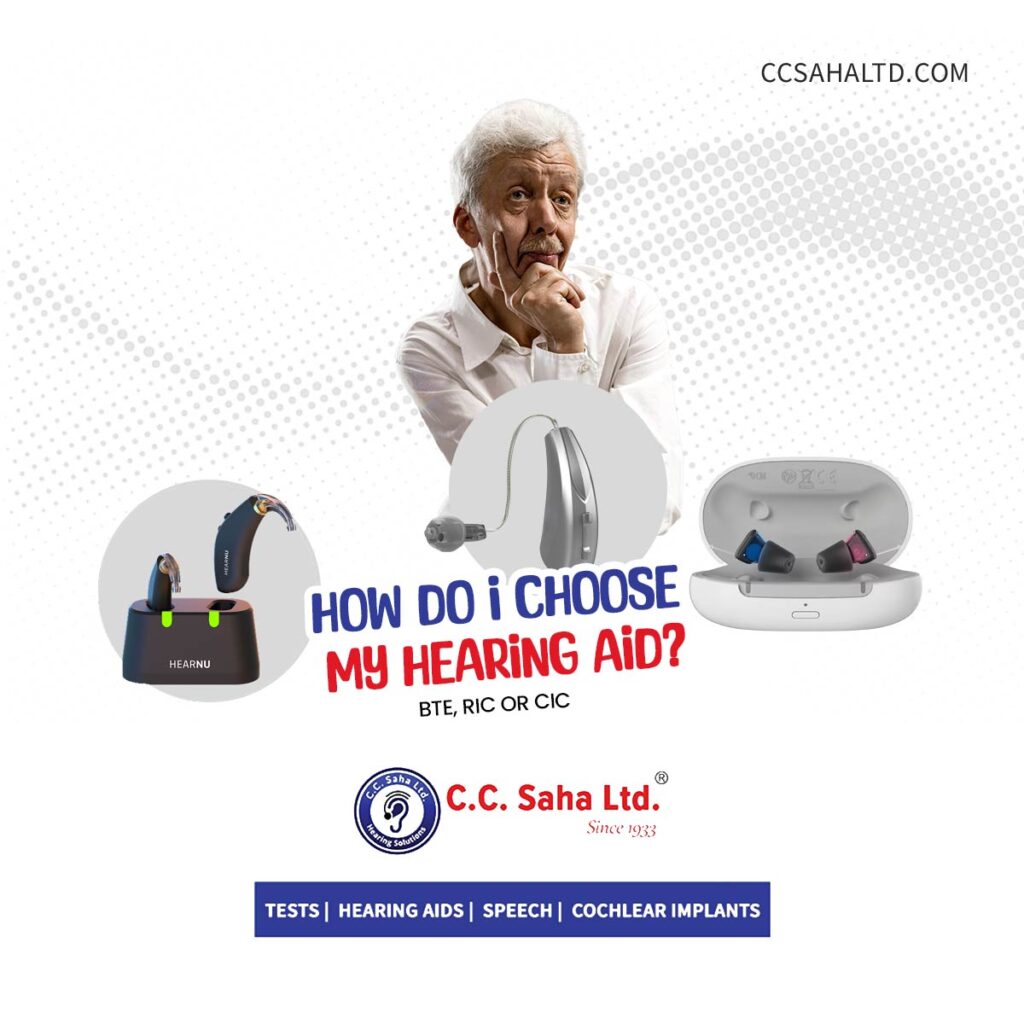
How Do I Choose
My Hearing Aid?

BTE, RIC or CIC

Choosing a hearing aid is a life-altering step toward reconnecting with the people, conversations, and environments that matter most to you. Yet, when sitting down to research your options, the landscape of clinical acronyms, differing form factors, and fast-evolving audio processing systems can feel incredibly overwhelming.

At CC Saha Ltd., a trusted name in auditory healthcare for decades, we firmly believe that asking “how do I choose my hearing aid” should not cause anxiety. Instead, it should be an empowering clinical journey toward tailored sound restoration.

Table of Contents
How-do-I-choose-my-hearing-aid---Kolkata--Audiology-Avenue---CC-Saha-Ltd

When patients walk into a CC Saha Ltd. clinic asking “how do I choose my hearing aid”, they often expect a simple recommendation. In practice, selecting the ideal hearing system requires an evaluation across four distinct pillars:

  1. Your Audiometric Profile: The severity and configuration of your hearing loss (e.g., high-frequency sloped vs. flat profound loss) dictate the acoustic power your device must deliver.
  2. Ear Canal Anatomy: The physical dimensions, shape, and moisture level of your ear canal determine whether an custom, in-the-canal device can comfortably sit inside your ear.
  3. Dexterity & Tactile Control: Your comfort level handling miniature electronics, changing tiny zinc-air cells, or interacting with localized push buttons impacts daily usability.
  4. Acoustic Lifestyle Environments: A retired individual reading at home requires a vastly different processing setup than an active business professional frequently navigating chaotic group boardrooms or windy outdoor job sites.

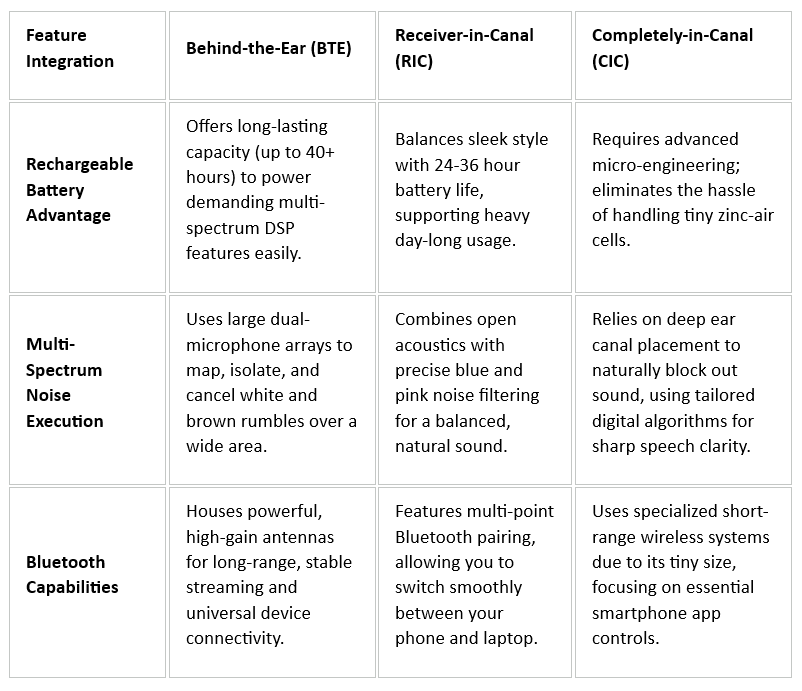
To provide clarity at a glance, the three primary structural styles of hearing instruments—Behind-the-Ear (BTE), Receiver-in-Canal (RIC), and Completely-in-Canal (CIC)—each solve unique aspects of these four pillars.

Behind-the-Ear (BTE) Instruments

The BTE architecture houses all critical electronic subcomponents—including dual microphone arrays, the digital signal processing (DSP) microchip, the power source, and the acoustic driver (speaker)—within a rugged plastic shell resting behind the pinna (outer ear). The amplified sound wave traveling from the internal speaker is pushed down through a sturdy, clear acoustic tube into a custom-moulded acrylic or silicone earmold that seals inside the user’s ear.

  • Clinical Ideal For: Mild to profound hearing loss, paediatric fittings, and individuals prone to heavy earwax accumulation or chronic outer-ear infections.
  • Acoustic Advantages: BTE housings provide ample physical space for large, high-output transducers. This design delivers maximum acoustic gain (volume) without creating feedback loops (whistling). The custom earmold ensures a reliable seal, maximizing low-frequency sound delivery for severe losses.
  • Physical Handling: Excellent for users dealing with arthritis or reduced fine-motor coordination. The larger size makes inserting, cleaning, and seating the instrument straightforward.
  • Disadvantages: It remains the most visually prominent option on the market and can sometimes compete for physical space behind the ear with eyeglasses or face masks.


Receiver-in-Canal (RIC) Instruments

RIC devices—sometimes called Receiver-in-the-Aid (RITE)—look similar to traditional BTEs from afar, but they use a completely different acoustic setup. While the processor and microphones stay inside the shell behind your ear, the speaker (receiver) is moved to the end of a micro-thin electrical wire covered in medical-grade polymer. This speaker sits directly inside your ear canal, wrapped in a soft, breathable dome or a tiny custom micro-mold.

  • Clinical Ideal For: Mild-to-severe high-frequency hearing loss (the typical “age-related” sloped hearing profile).
  • Acoustic Advantages: By taking the speaker out of the main case and placing it directly into the ear canal, RIC instruments deliver crystal-clear, distortion-free sound. The open-fit domes let natural low-frequency sounds enter the ear canal on their own. This completely eliminates the “occlusion effect”—that annoying, boomy sensation where your own voice sounds like you’re talking into a barrel.
  • Physical Handling: The lightweight housing sits comfortably behind the ear, while the ultra-thin wire remains virtually invisible.
  • Disadvantages: Because the speaker sits directly inside the ear canal, it is highly exposed to earwax, oils, and moisture. Users must be diligent about replacing tiny wax guards to prevent component damage.


Completely-in-Canal (CIC) Instruments

 CIC hearing aids are custom-tailored miniatures built from a physical silicone impression or a 3D digital scan of your ear canal. The entire device slides completely inside the ear canal, leaving only a tiny monofilament pull-cord visible to help you remove it.

  • Clinical Ideal For: Mild-to-moderate hearing losses in individuals who prioritize maximum cosmetic discretion.
  • Acoustic Advantages: Because the device sits deep inside the ear, it takes full advantage of the pinna’s natural acoustic shape. This helps you naturally pinpoint where sounds are coming from and reduces annoying wind noise when you’re outdoors.
  • Physical Handling: Requires a steady hand and good eyesight to clean filters and change small components.
  • Disadvantages: Their tiny size leaves no room for directional microphones or bulky Bluetooth antennas. They are also prone to the occlusion effect and require a well-vented shell to keep your own voice sounding natural.

As digital signal processing gets faster and more efficient, modern hearing instruments do much more than simply make sounds louder. Three major features defining the modern listening experience are lithium-ion rechargeability, multi-spectrum noise cancellation, and universal Bluetooth connectivity.


Demystifying Multi-Spectrum Noise Cancellation in Audiology

While standard hearing aids treat all background noise the same, advanced processors divide sound into specific colour spectrums. This allows the device to apply precise, out-of-phase cancellation to match the exact environment you are in.

White Noise Cancellation: White noise distributes energy equally across all frequencies, sounding like a steady static hum or a whirring fan. Cancelling white noise helps eliminate the constant background drone of air conditioners, engines, and server rooms.

Pink Noise Cancellation: Pink noise has deeper sound layers because its energy drops by 3 decibels per octave as the frequency rises. This mimics the balanced sound of steady rain or rustling leaves. Precise pink noise management prevents these broad environmental sounds from masking nearby conversations.

Blue Noise Cancellation: Blue noise is the opposite of pink; its energy increases by 3 decibels per octave as the frequency goes up. This gives it a high-pitched, sharp quality—similar to a hissing water valve. In audiology, blue noise algorithms serve two vital purposes:

Tinnitus Masking: The high-frequency focus blends with the pitch of most neurogenic tinnitus (ringing in the ears), retraining the brain to ignore the internal sound.

High-Frequency Speech Sharpening: Out-of-phase blue noise cancellation suppresses harsh environmental clatter (like clinking silverware or screeching brakes) without dampening high-frequency speech consonants like $s$, $f$, and $t$.

Brown Noise Cancellation: Brown noise drops its energy heavily by 6 decibels per octave, resulting in a deep, low, rumbling roar like a distant waterfall or heavy thunder. Canceling brown noise is crucial for removing low-end structural vibrations and heavy traffic rumble.

Acoustic Energy Density Profiles

Brown Noise ── Deepest rumble (-6dB/octave) ── Targets heavy traffic/vibrations

Pink Noise ── Balanced depth (-3dB/octave)  ── Targets wind/rain/rustling environments

White Noise ── Flat, equal energy spectrum   ── Targets mechanical/fan drone

Blue Noise ── High-frequency hiss (+3dB/oct) ── Targets clatter & provides tinnitus relief

Call Us for Support

[Mon – Sat, 10am – 6:30pm]

Modern hearing aids double as premium wireless headsets. Using optimized low-energy Bluetooth protocols, they allow for hands-free phone calls, direct stereo streaming from smartphones and TVs, and remote adjustments via companion apps. This wireless link works in tandem with the noise cancellation system, ensuring that streamed audio remains crisp even in noisy settings.

Features and styles of Hearing Aids

Finding Your Perfect Mix

Balancing battery life, noise cancellation needs, and Bluetooth features requires a personalized touch. Our team can help you pick the exact combination that fits your lifestyle.

Choosing the right style is only half the battle; the processor inside your hearing aid acts as the engine that powers your hearing. At CC Saha Ltd., we thoroughly evaluate and select premium platforms that provide real, noticeable benefits in everyday life.


Phonak Audio Infinio (Featuring the DEEPSONIC DNN Chip)

Phonak’s latest flagship RIC instrument, the Audio Infinio, marks a massive leap forward in hearing technology by introducing DEEPSONIC, the world’s first dedicated Deep Neural Network (DNN) microchip.

  • Spheric Speech Clarity: This dedicated chip instantly separates speech from background noise from any direction. It delivers an incredible 10 dB improvement in the signal-to-noise ratio (SNR), meaning your chances of understanding individual words in chaotic environments are instantly doubled.
  • Universal Connectivity: Built on ultra-responsive Bluetooth architectures, the Infinio can pair with up to eight devices and maintain two active connections at the same time. It effortlessly switches between direct audio streaming and ambient sound across double the distance of previous models.
  • Clinical Verdict: Ideal for individuals who frequently find themselves in extremely loud social situations, busy restaurants, or complex corporate environments where listening fatigue used to be a major obstacle.


Signia Pure Charge & Go IX (Integrated Experience)

Signia’s Pure Charge & Go IX completely redefines how hearing aids handle group conversations through its groundbreaking RealTime Conversation Enhancement architecture.

  • Multi-Stream Real-Time Tracking: Traditional hearing aids focus strictly on the person standing directly in front of you. The Signia IX platform uses a real-time split-processing system that maps your entire surroundings 100 times per second. It tracks multiple moving speakers simultaneously, dynamically adjusting its focus to keep you included in the conversation.
  • Premium Charging Options: The device offers up to 36 hours of battery life on a single charge. It pairs with the Pure Dry & Clean charging case, which utilizes integrated UV-C light cycles to sanitize and dry out moisture in just 15 minutes.
  • Clinical Verdict: A perfect choice for lively family dinners, round-table business meetings, and dynamic social gatherings where conversations naturally jump from one person to another.


Starkey Signature Series

For patients who want absolute discretion without sacrificing modern performance, Starkey has created something truly remarkable with the Signature Series.

  • The World’s Smallest Custom Rechargeable: Starkey has achieved an industry first: a custom-moulded Completely-in-Canal (CIC) device featuring a fully integrated lithium-ion rechargeable battery. This tiny powerhouse delivers up to 38 hours of battery life on a single charge.
  • Neuro Sound Technology & Edge Mode+: Powered by advanced processors that mimic the central auditory system, the Signature Series features Edge Mode+. With a simple tap on your ear, onboard AI instantly analyses your environment and recalibrates the sound, prioritizing speech clarity or comfort on demand.
  • Exceptional Durability: Every device is custom-cast with an IP68 waterproof rating up to 1 meter deep, offering exceptional protection against moisture and earwax.
  • Clinical Verdict: The ultimate discrete option for users who want their hearing aids to remain invisible, but still demand top-tier sound processing and rechargeable convenience.

Call Us for Support

[Mon – Sat, 10am – 6:30pm]

FAQs

Q1. How do I choose my hearing aid style if I wear glasses?

When choosing a hearing aid as a glasses wearer, physical space behind the pinna is your primary consideration. RIC instruments are generally preferred over traditional BTEs because their thin receiver wires take up minimal room alongside glasses frames. Alternatively, if your audiogram allows, a custom custom-moulded CIC device like the Starkey Signature Series bypasses the back of the ear entirely, eliminating physical overlap with your glasses.

Q2. Does a more expensive hearing aid mean better hearing?

A premium price tag doesn’t mean the device is simply “louder”—it reflects the processing power of the computer chip inside. High-tier models contain advanced algorithms that analyze, clean, and prioritize sound up to 100 times per second. This enables complex features like Signia’s multi-speaker tracking or Phonak’s Deep Neural Network noise reduction, which are essential for clear hearing in noisy environments.

Q3. Are rechargeable hearing aids better than battery-operated ones?

Rechargeable lithium-ion setups are highly recommended for most lifestyles due to their reliability, ease of use, and eco-friendly design. They eliminate the hassle of handling tiny, single-use zinc-air batteries every few days. More importantly, rechargeable power is essential for running power-heavy features like continuous Bluetooth streaming and real-time noise cancellation without constant power drops.

Q4. Can I connect my hearing aid directly to my smartphone?

Yes, most modern RIC and BTE instruments feature native Bluetooth integration. Platforms like the Phonak Audio Infinio offer universal connectivity to both Apple iOS and Android ecosystems, allowing you to stream phone calls, music, and videos directly into your ears while enjoying hands-free calling. However, ultra-small custom CIC devices often leave out wireless streaming antennas to maintain their tiny size.

Q5. How long do modern hearing aids usually last?

High-quality digital hearing aids typically have an operational lifespan of 5 to 7 years. The mechanical components themselves are built to last, but changes in your personal hearing profile or leaps in audio processing technology over time often lead patients to upgrade their devices before they physically wear out.

Q6. Will a hearing aid stop my tinnitus completely?

While hearing aids are not a cure for tinnitus, they are highly effective at managing it. By bringing back the ambient background sounds you’ve been missing, they naturally draw your brain’s focus away from internal ringing. Additionally, advanced platforms feature customizable sound therapy tools—like blue noise generation—to help soothe and mask persistent tinnitus.

Q7. Is the RIC style definitively better than the traditional BTE style?

Neither style is universally “better”; your choice depends entirely on your specific hearing needs. RIC devices offer superior cosmetic discretion and a more open, natural sound, making them perfect for mild-to-severe high-frequency hearing loss. On the other hand, traditional BTE models remain the gold standard for severe-to-profound hearing loss because their larger size provides the necessary physical stability and acoustic power.

Q8. What is the “occlusion effect” and how can I avoid it?

The occlusion effect is that boomy, echoey sensation where your own voice sounds like you’re talking inside a barrel. It occurs when a hearing aid completely blocks off your ear canal, trapping the low-frequency sound vibrations generated by your vocal cords when you speak. You can easily minimize this by choosing an open-fit RIC device or ensuring a custom CIC shell is built with a proper ventilation channel.

Q9. How often should I have my hearing aids checked and adjusted?

We recommend visiting your audiologist for a routine check-up and professional cleaning every 6 months. Your hearing profile can change gradually over time, and regular visits allow us to fine-tune your devices to match your latest audiogram while checking that the hardware is performing at its best.

Q10. Why should I choose CC Saha Ltd. for my hearing journey?

Choosing a hearing aid is only the first step—the true key to better hearing lies in the clinical precision of the fitting process. At CC Saha Ltd., every recommendation is backed by a deeply rooted commitment to clinical expertise, state-of-the-art diagnostic testing, and dedicated long-term care. This level of personalized attention ensures your device is perfectly matched to your lifestyle, delivering a level of confidence and clarity that an online store simply cannot match.

 

📞Take the Next Step Toward Clear Hearing

Your personal hearing needs are unique. Rather than trying to navigate the choice alone, let our experienced audiologists guide you to the perfect solution.

Book Your Free Hearing Aid Trial Today: Click Here to Book Your Appointment

Speak to an Expert: Call our Toll-Free number 1800 570 9930 (Available Mon-Sat | 10:00 am – 6:30 pm)

Visit CC Saha Ltd.—90 Years of Trust and Excellence.

#HowDoIChooseMyHearingAid #HearingAidGuide #AudiologyAvenue #CCSahaLtd #PhonakInfinio #SigniaIX #StarkeySignature #RechargeableHearingAids #HearingLossSolutions #AudiologyExpertise #CCSahaLtd #AudiologyAvenue

Read More...
AI-Powered-Hearing-Aids----Revolutionizing--Sound---CC-Saha-Ltd
AI-Powered Hearing Aids  – Revolutionizing  Sound

Step into the future of hearing with AI-Powered Hearing Aids. This revolutionary technology goes far beyond simple amplification, offering personalized sound experiences, seamless smart device integration, and addressing the stigma often associated with hearing loss. Discover how CC Saha Ltd. can help you unlock a world of enhanced sound.

Read More »
Stuttering-Treatment-in-Kolkata-for-Adults-and-Children---CC-Saha-Ltd
Stuttering Treatment in Kolkata for Adults and Children

Discover comprehensive stuttering treatment for adults and children at CC Saha Ltd. Esplanade Clinic in Kolkata. Learn how expert therapy, personalized plans, and a supportive environment can help overcome stuttering and build lasting communication confidence, inspired by King George VI’s journey.

Read More »
Hearing aid battery tips for Kolkata: Powering Your World of Sound with CC Saha Ltd.
Hearing aid battery tips for Kolkata

The unique climate of Kolkata, with its characteristic humidity, can present specific challenges for hearing aid batteries. Understanding the nuances of battery types, whether disposable or rechargeable, can significantly extend their life and the performance of your devices. Let’s delve into the best practices that will keep your hearing aids powered up and you connected to the world. At CC Saha Ltd., we believe in empowering you with knowledge, and these hearing aid battery tips for Kolkata are a testament to that commitment.

Read More »