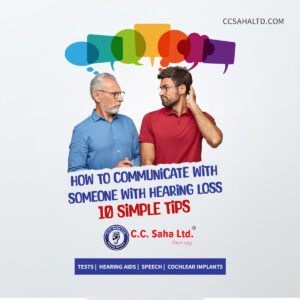
How to Communicate with Someone with Hearing Loss: 10 Simple Tips
Want to communicate with someone with hearing loss better? Here’s a simple guide. Book a hearing test at CC Saha Ltd. today!
For parents navigating the silent world of a child with hearing loss, the journey toward sound can feel overwhelming. However, the evaluation for paediatric cochlear implants (CI) serves as a structured roadmap designed to determine if this revolutionary technology is the right fit for your little one. At C.C. Saha Ltd, we understand that every moment counts in a child’s developmental timeline. A cochlear implant is not just a medical device; it is a gateway to language, education, and social integration.
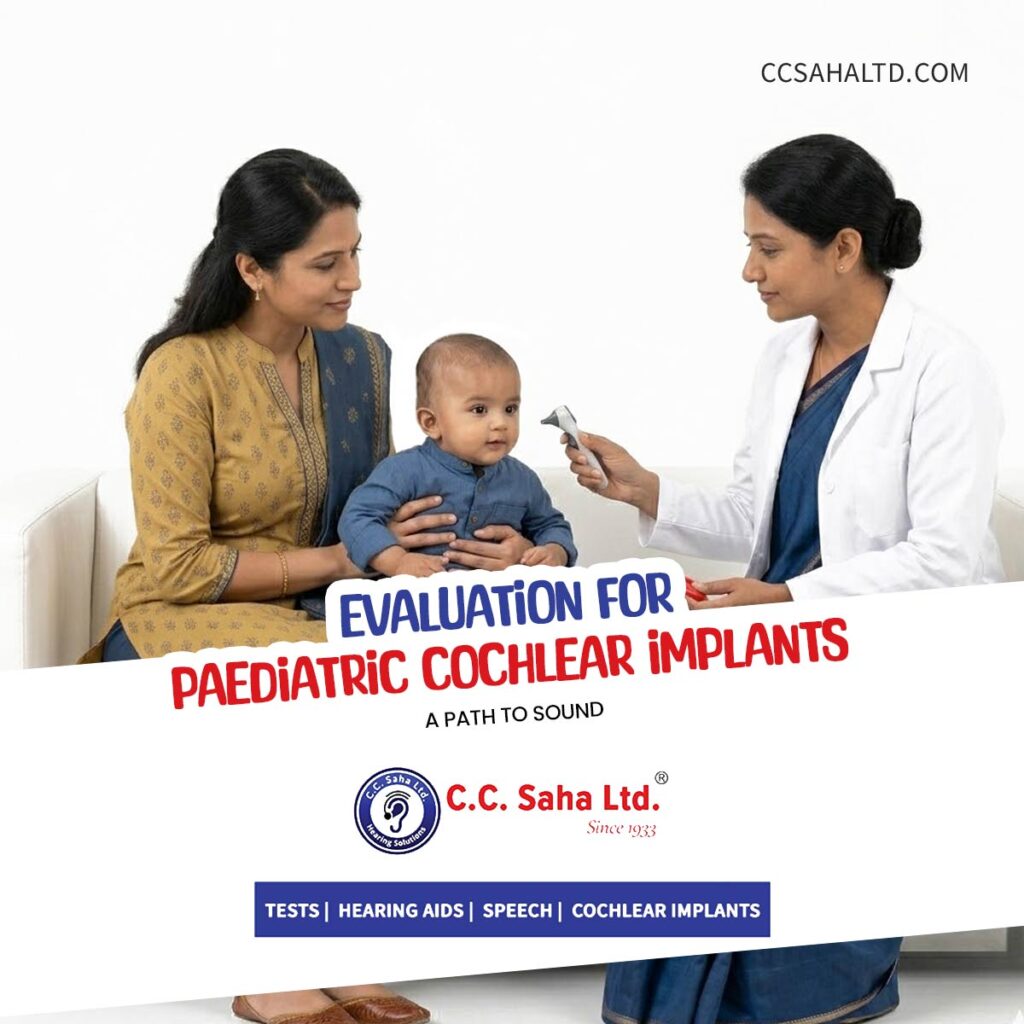
The evaluation process begins with awareness. Parents are often the first to notice that something is amiss. Early symptoms of significant hearing loss in infants and toddlers include:
One of the most critical aspects of the candidacy criteria and evaluation for paediatric cochlear implants is the element of time. The human brain is hardwired for language acquisition during a “critical period,” typically between birth and age three.
Auditory deprivation—the lack of sound stimulation to the brain—can lead to permanent developmental delays. Delaying the decision to pursue a CI evaluation can result in:
Determining candidacy is an intensive, multi-disciplinary effort. At specialized centers like C.C. Saha Ltd, the evaluation for paediatric cochlear implants involves several key stages:
The core of the evaluation is confirming the degree of hearing loss. Specialists use Auditory Brainstem Response (ABR) and Otoacoustic Emissions (OAE) tests, which are objective measures that do not require the child to respond actively. If the results show bilateral severe-to-profound sensorineural hearing loss, the child moves to the next phase.
Standard paediatric cochlear implant criteria usually require a trial period with high-powered, professionally fitted hearing aids. If the child shows “limited benefit”—meaning they still cannot access the speech spectrum—the CI becomes the recommended path.
An ENT surgeon performs a physical examination, while CT scans or MRIs are used to check the anatomy of the inner ear. It is vital to ensure the cochlea is formed correctly and the auditory nerve is present to carry signals to the brain.
An SLP (Speech-Language Pathologist) assesses the child’s current communication levels and the family’s commitment to post-implant rehabilitation, which is crucial for success.
While specific protocols vary, the general candidacy criteria for paediatric cochlear implants include:
The technology behind these implants is advancing rapidly. Today’s devices are smaller, smarter, and more “future-proof.”
Med-El is renowned for its Triformance technology, which aims to provide a more natural sound quality by covering the entire length of the cochlea. Their latest implants are also MRI-safe at 3.0 Tesla without the need for magnet removal—a huge relief for parents.
The Nucleus 8 Sound Processor is the world’s smallest and lightest behind-the-ear processor. It features SmartSound iQ2 with SCAN 2, which automatically adjusts to noisy environments like classrooms, and offers direct streaming from compatible Apple and Android devices.
When a child meets the Candidacy criteria and evaluation process for paediatric cochlear implants and receives the device early, the results are often miraculous. With proper mapping (tuning) and aural rehabilitation, these children can:
The implant doesn’t “cure” deafness, but it bypasses the damaged part of the ear to provide a high-fidelity digital version of sound that the brain learns to interpret perfectly.
EXCELLENTTrustindex verifies that the original source of the review is Google. Best servicePosted onTrustindex verifies that the original source of the review is Google. All type of hearing aids are availablePosted onTrustindex verifies that the original source of the review is Google. A trusted and familiar hearing aids clinicPosted onTrustindex verifies that the original source of the review is Google. Signia best h/aidPosted onTrustindex verifies that the original source of the review is Google. Signia best hearing aidPosted onTrustindex verifies that the original source of the review is Google. Signia best hearing aidPosted onTrustindex verifies that the original source of the review is Google. A range of hearing aids are availablePosted onTrustindex verifies that the original source of the review is Google. Very fast and prompt service......liked itPosted onTrustindex verifies that the original source of the review is Google. Hearing machine in good condition, staff is good and polite.Posted onTrustindex verifies that the original source of the review is Google. Best hearing aidsVerified by TrustindexTrustindex verified badge is the Universal Symbol of Trust. Only the greatest companies can get the verified badge who has a review score above 4.5, based on customer reviews over the past 12 months. Read more
Q1. What is the ideal age for a child to get a cochlear implant?
Most experts recommend implantation between 9 and 12 months, though some latest Med-El approvals allow for 7 months in specific cases.
Q2. Does the surgery involve the brain?
No. The surgery involves the inner ear (cochlea) and the area just under the skin behind the ear. It does not involve brain surgery.
Q3. Is the evaluation process painful for the child?
Not at all. Most tests like ABR are done while the child is sleeping or under light sedation to ensure they stay still.
Q4. Can a child with a cochlear implant swim? Yes. Both Med-El and Cochlear offer “Aqua” accessories or waterproof processors that allow children to swim and bathe while hearing.
Q5. How long does the evaluation process take?
It typically takes a few weeks to a couple of months to complete all the audiological, medical, and speech assessments.
Q6. What if my child has some residual hearing?
Many children with residual hearing now qualify for “Electro-Acoustic Stimulation” (EAS), which combines a hearing aid for low frequencies and an implant for high frequencies.
Q7. Is the internal part of the implant permanent?
Yes, the internal component is designed to last a lifetime, though the external processor is usually upgraded every 5–7 years as technology improves.
Q8. Will my child need special schooling?
Many children who receive early implants are able to “mainstream” into regular schools with minimal support.
Q9. Are both ears implanted at once?
Bilateral implantation (both ears) is increasingly common and recommended to help children localize sound and hear better in noisy environments.
Q10. Where can I start the Candidacy criteria and evaluation process for paediatric cochlear implants in Kolkata?
C.C. Saha Ltd provides comprehensive support, from initial diagnosis and evaluation to post-operative mapping and therapy.
Don’t let silence define your child’s future.
Understanding the Candidacy criteria and evaluation for paediatric cochlear implants is the first step toward a world of sound. CC Saha Ltd. there with you all the way from evaluation, surgery, switch-on, mapping, and rehabilitation & speech therapy.
Book your childs first check: Click Here to Book Your Appointment
Speak to an Expert: Call our Toll-Free number 1800 570 9930 (Available Mon-Sat | 10:00 am – 6:30 pm)
Visit CC Saha Ltd.—Where 90 years of trust meets the future of hearing technology.
Want to communicate with someone with hearing loss better? Here’s a simple guide. Book a hearing test at CC Saha Ltd. today!

If you hear a strange wind noise in your ears, you’re not alone. Discover the causes, get expert solutions, and find the best help at CC Saha Ltd. in Kolkata!
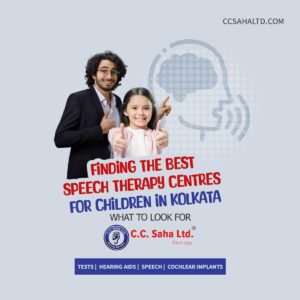
Explore the best speech therapy centers for children in Kolkata with our expert guide for modern parents seeking quality care and communication support.

Explore the emerging health connection between fatty liver and hearing loss, especially among Kolkata’s young urban adults this World Liver Day.
Yes, you can live a normal and fulfilling life with hearing loss. Here’s how to embrace it, adapt, and thrive in Kolkata’s vibrant urban rhythm.
Approximately 50% of individuals aged 75 years and beyond encounters a diminution of 35 decibels or more in their auditory acuity—a juncture necessitating the employment of a hearing augmentation device. The younger generations are catching up too.