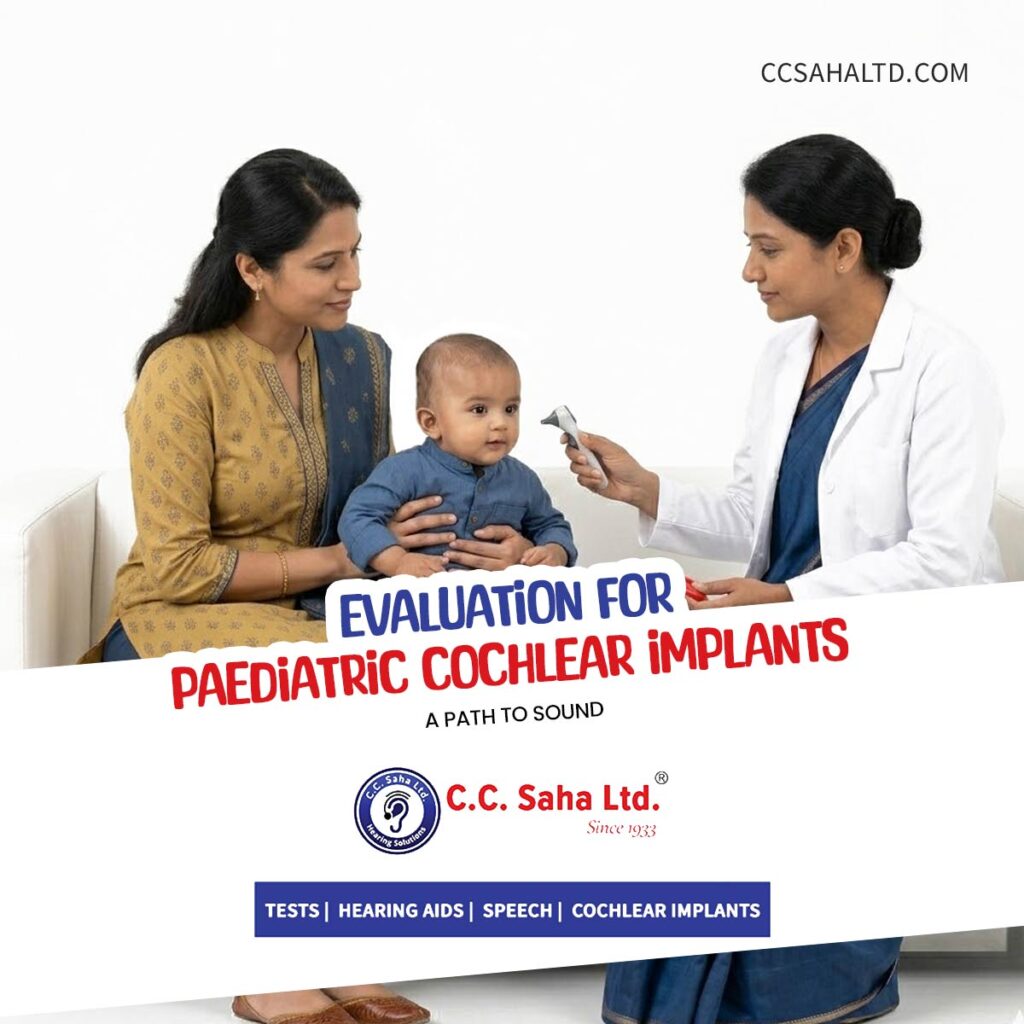
Evaluation for
Paediatric Cochlear Implants

A Path to Sound

For parents navigating the silent world of a child with hearing loss, the journey toward sound can feel overwhelming. However, the evaluation for paediatric cochlear implants (CI) serves as a structured roadmap designed to determine if this revolutionary technology is the right fit for your little one. At C.C. Saha Ltd, we understand that every moment counts in a child’s developmental timeline. A cochlear implant is not just a medical device; it is a gateway to language, education, and social integration.

Table of Contents
Evaluation-for-paediatric-cochlear-implants---Audiology-Avenue---CC-Saha-Ltd

The evaluation process begins with awareness. Parents are often the first to notice that something is amiss. Early symptoms of significant hearing loss in infants and toddlers include:

  • Lack of Startle Reflex: The child does not jump or cry at loud, sudden noises.
  • No Response to Voice: By 6 months, the child does not turn their head toward a parent’s voice or familiar sounds.
  • Delayed Babbling: A lack of varied vocalizations or “stopped” babbling around 9 months.
  • Failure to Follow Instructions: Older toddlers may seem “disobedient” but are actually unable to hear spoken commands.

One of the most critical aspects of the candidacy criteria and evaluation for paediatric cochlear implants is the element of time. The human brain is hardwired for language acquisition during a “critical period,” typically between birth and age three.

Auditory deprivation—the lack of sound stimulation to the brain—can lead to permanent developmental delays. Delaying the decision to pursue a CI evaluation can result in:

  1. Stunted Speech Development: Without hearing, a child cannot mirror the sounds needed to speak.
  2. Cognitive Gaps: Hearing is essential for processing information and learning complex concepts.
  3. Social Isolation: Children may struggle to form bonds with peers, leading to emotional distress and withdrawal.

Determining candidacy is an intensive, multi-disciplinary effort. At specialized centers like C.C. Saha Ltd, the evaluation for paediatric cochlear implants involves several key stages:

1. Audiological Assessment

The core of the evaluation is confirming the degree of hearing loss. Specialists use Auditory Brainstem Response (ABR) and Otoacoustic Emissions (OAE) tests, which are objective measures that do not require the child to respond actively. If the results show bilateral severe-to-profound sensorineural hearing loss, the child moves to the next phase.

2. The Hearing Aid Trial

Standard paediatric cochlear implant criteria usually require a trial period with high-powered, professionally fitted hearing aids. If the child shows “limited benefit”—meaning they still cannot access the speech spectrum—the CI becomes the recommended path.

3. Medical and Imaging Clearance

An ENT surgeon performs a physical examination, while CT scans or MRIs are used to check the anatomy of the inner ear. It is vital to ensure the cochlea is formed correctly and the auditory nerve is present to carry signals to the brain.

4. Speech and Language Evaluation

An SLP (Speech-Language Pathologist) assesses the child’s current communication levels and the family’s commitment to post-implant rehabilitation, which is crucial for success.

Call Us for Support

[Mon – Sat, 10am – 6:30pm]

  • While specific protocols vary, the general candidacy criteria for paediatric cochlear implants include:

    • Age: Children as young as 7 to 9 months are now being implanted to maximize the neuroplasticity of the brain.
    • Degree of Loss: Typically bilateral profound sensorineural hearing loss (70–90+ dB).
    • Lack of Progress: Minimal improvement in auditory skills despite consistent hearing aid use.
    • Support System: A family environment dedicated to long-term mapping and therapy.

The technology behind these implants is advancing rapidly. Today’s devices are smaller, smarter, and more “future-proof.”

Med-El (Synchrony System)

Med-El is renowned for its Triformance technology, which aims to provide a more natural sound quality by covering the entire length of the cochlea. Their latest implants are also MRI-safe at 3.0 Tesla without the need for magnet removal—a huge relief for parents.

Cochlear (Nucleus 8)

The Nucleus 8 Sound Processor is the world’s smallest and lightest behind-the-ear processor. It features SmartSound iQ2 with SCAN 2, which automatically adjusts to noisy environments like classrooms, and offers direct streaming from compatible Apple and Android devices.

When a child meets the Candidacy criteria and evaluation process for paediatric cochlear implants and receives the device early, the results are often miraculous. With proper mapping (tuning) and aural rehabilitation, these children can:

  • Attend mainstream schools and participate in all classroom activities.
  • Enjoy music, talk on the telephone, and play sports (using protective gear).
  • Develop speech that is indistinguishable from their hearing peers.


The implant doesn’t “cure” deafness, but it bypasses the damaged part of the ear to provide a high-fidelity digital version of sound that the brain learns to interpret perfectly.

Call Us for Support

[Mon – Sat, 10am – 6:30pm]

10 FAQs on Paediatric Cochlear Implant

Q1. What is the ideal age for a child to get a cochlear implant?

Most experts recommend implantation between 9 and 12 months, though some latest Med-El approvals allow for 7 months in specific cases.

Q2. Does the surgery involve the brain?

No. The surgery involves the inner ear (cochlea) and the area just under the skin behind the ear. It does not involve brain surgery.

Q3. Is the evaluation process painful for the child?

Not at all. Most tests like ABR are done while the child is sleeping or under light sedation to ensure they stay still.

Q4. Can a child with a cochlear implant swim? Yes. Both Med-El and Cochlear offer “Aqua” accessories or waterproof processors that allow children to swim and bathe while hearing.

Q5. How long does the evaluation process take?

 It typically takes a few weeks to a couple of months to complete all the audiological, medical, and speech assessments.

Q6. What if my child has some residual hearing?

Many children with residual hearing now qualify for “Electro-Acoustic Stimulation” (EAS), which combines a hearing aid for low frequencies and an implant for high frequencies.

Q7. Is the internal part of the implant permanent?

Yes, the internal component is designed to last a lifetime, though the external processor is usually upgraded every 5–7 years as technology improves.

Q8. Will my child need special schooling?

Many children who receive early implants are able to “mainstream” into regular schools with minimal support.

Q9. Are both ears implanted at once?

Bilateral implantation (both ears) is increasingly common and recommended to help children localize sound and hear better in noisy environments.

Q10. Where can I start the Candidacy criteria and evaluation process for paediatric cochlear implants in Kolkata?

C.C. Saha Ltd provides comprehensive support, from initial diagnosis and evaluation to post-operative mapping and therapy.

Don’t let silence define your child’s future.

Understanding the Candidacy criteria and evaluation for paediatric cochlear implants is the first step toward a world of sound. CC Saha Ltd. there with you all the way from evaluation, surgery, switch-on, mapping, and rehabilitation & speech therapy.

Book your childs first check: Click Here to Book Your Appointment

Visit CC Saha Ltd.—Where 90 years of trust meets the future of hearing technology.

Read More...
Pediatric Speech & Language Development

Understanding early childhood milestones is crucial for every parent. This deep-dive guide into Pediatric Speech & Language Development covers speech delay in toddlers, age-specific milestones from 2 to 5, the diagnostic role of a psychometric test for speech therapy, and the hidden link between pediatric hearing health and language production. Learn how a trusted pediatric speech therapist Kolkata can help unleash your child’s full potential.

Read More »
How to protect hearing aids from moisture and humidity
How to Protect Hearing Aids from Moisture and Humidity

Wondering how to protect hearing aids from moisture and humidity this rainy season? Discover how high humidity triggers battery compartment damage, the value of a hearing aid dehumidifier, and where to find top-tier waterproof hearing aids in Kolkata to safeguard your hearing health against monsoon ear infections.

Read More »
How-do-I-choose-my-hearing-aid---Kolkata--Audiology-Avenue---CC-Saha-Ltd
When Do You Need a BERA or ASSR Test?

While pure-tone audiometry remains the bedrock of hearing healthcare, it relies heavily on conscious patient feedback. Read our complete expert guide, Beyond the Standard Audiogram: When Do You Need a BERA or ASSR Test? to explore how objective brainwave tracking changes how we diagnose complex hearing issues.

Read More »
How-do-I-choose-my-hearing-aid---Kolkata--Audiology-Avenue---CC-Saha-Ltd
How Do I Choose My Hearing Aid?

If you’ve ever asked yourself, “how do I choose my hearing aid,” you aren’t alone. This 1,800-word authoritative breakdown from Audiology Avenue covers acoustic profiles, rechargeable blue noise cancellation, and leading devices from Phonak, Signia, and Starkey.

Read More »