High-quality Hearing Aids In Kolkata
We understand how important your sense of hearing is to both you and your family. Our team of professionals is ready to help find the right hearing aid for your individual hearing needs.
When parents evaluate their child’s development, obvious signs of auditory impairment—such as failing to respond to loud noises or consistently turning up the television volume to maximum levels—prompt quick medical consultations. However, a far more elusive auditory condition called hidden hearing loss in children frequently slips past traditional screening methods.
Children experiencing hidden hearing loss in children often pass standard pure-tone audiometry tests with flying colors in quiet environments. Yet, when placed in real-world scenarios like bustling classrooms, playgrounds, or noisy family gatherings, their ability to process speech degrades significantly.
At CC Saha Ltd., through our dedicated publication Audiology Avenue, we emphasize that identifying hidden hearing loss in children requires looking beyond basic audiological thresholds. Understanding the subtle behavioral nuances, neurological mechanics, and speech progression markers can help parents intervene before academic, social, and emotional challenges compound.
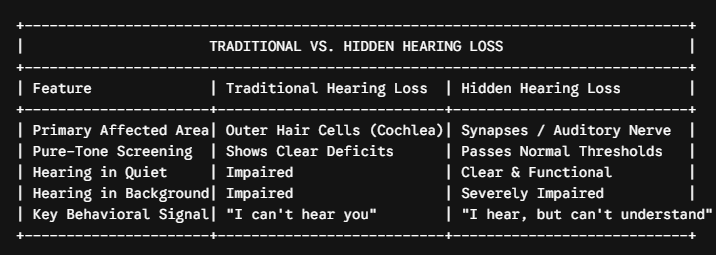
To understand hidden hearing loss in children, one must examine the neural pathways connecting the inner ear to the brain. Traditional hearing tests assess sound sensitivity—determining the softest decibel level at which a child hears a tone across various frequencies. This test evaluates the functionality of outer hair cells inside the cochlea.
However, hidden hearing loss in children primarily involves damage to the synaptic connections between inner hair cells and the auditory nerve fibers—a condition known clinically as cochlear synaptopathy or auditory neuropathy spectrum disorder (ANSD).
Because hair cells remain intact, a child with hidden hearing loss in children registers sound normally in quiet test booths. However, because synaptic pathways are compromised or desynchronized, sound signals arrive at the brain corrupted or incomplete, especially when competing background noise is present.
When observing child hearing problems, parents often hear their child say, “I hear you, but I don’t know what you’re saying.” Identifying hidden hearing loss in children early prevents chronic academic underperformance and behavioral misunderstandings.
Recognizing hidden hearing loss in children requires observing how a child handles daily auditory environments rather than rely solely on standard school hearing checks. Watch for these five key warning signals:
A primary indicator of hidden hearing loss in children is an inability to filter out ambient sound. While the child converses easily at a quiet dinner table, they may become completely lost at a restaurant, inside a classroom, or at a park.
Listening with hidden hearing loss in children requires massive cognitive strain. Because the brain must constantly fill in missing phonetic fragments from damaged nerve signals, the child works exponentially harder to listen than their peers.
Because hidden hearing loss in children disrupts auditory processing efficiency, multi-step verbal directives become jumbled.
Proper language development relies on clear neural encoding of speech sounds. Children with hidden hearing loss in children often struggle to distinguish between subtle phonetic variations, particularly consonant blends like /s/, /f/, /th/, or voiceless stops /p/, /t/, /k/.
Navigating noisy peer environments with detecting hidden hearing loss in children issues can feel frustrating and isolating.
A common diagnostic challenge when evaluating hidden hearing loss in children is distinguishing between a primary speech/language delay, an auditory processing disorder (APD), and underlying synaptopathy.
EXCELLENTTrustindex verifies that the original source of the review is Google. Best servicePosted onTrustindex verifies that the original source of the review is Google. All type of hearing aids are availablePosted onTrustindex verifies that the original source of the review is Google. A trusted and familiar hearing aids clinicPosted onTrustindex verifies that the original source of the review is Google. Signia best h/aidPosted onTrustindex verifies that the original source of the review is Google. Signia best hearing aidPosted onTrustindex verifies that the original source of the review is Google. Signia best hearing aidPosted onTrustindex verifies that the original source of the review is Google. A range of hearing aids are availablePosted onTrustindex verifies that the original source of the review is Google. Very fast and prompt service......liked itPosted onTrustindex verifies that the original source of the review is Google. Hearing machine in good condition, staff is good and polite.Posted onTrustindex verifies that the original source of the review is Google. Best hearing aidsVerified by TrustindexTrustindex verified badge is the Universal Symbol of Trust. Only the greatest companies can get the verified badge who has a review score above 4.5, based on customer reviews over the past 12 months. Read more
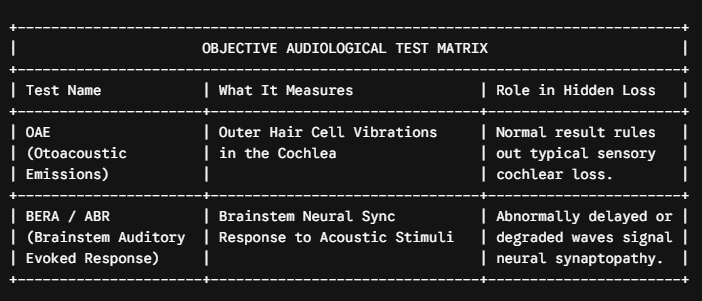
A child with a pure speech delay struggles with language production, expressive vocabulary, or motor-speech planning. Their ability to process and comprehend auditory information remains consistent regardless of background acoustic clutter. In quiet environments or noisy rooms, their receptive understanding remains unchanged.
Conversely, auditory processing issues kids face center on sound perception and neural encoding rather than language formulation.
Proper differentiation requires comprehensive evaluation by a qualified pediatric audiologist utilizing advanced electrophysiological diagnostics.
When standard behavioral hearing screenings fail to capture underlying neural deficits, objective electrophysiological evaluations become essential for detecting hidden hearing loss in children.
At CC Saha Ltd., our pediatric audiology protocols integrate advanced objective testing metrics to assess the entire auditory pathway—from the outer ear canal to the brainstem.
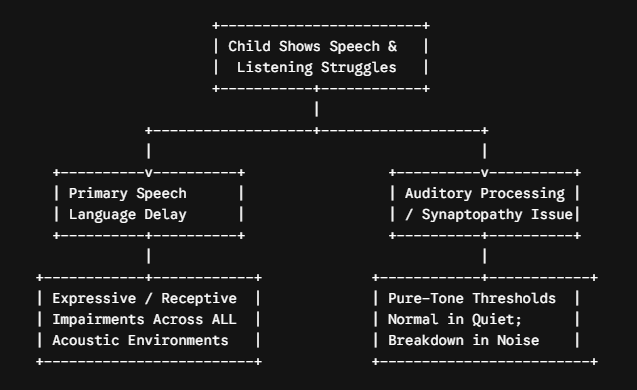
The OAE test evaluates inner ear hair cell function. A miniature probe placed in the ear canal delivers soft clicking sounds and records the tiny echo (“emission”) produced by healthy outer hair cells.
The BERA test (also known as ABR) measures electrophysiological brainwave activity in response to sound. Electrodes placed gently on the child’s scalp record neural signals as acoustic clicks pass along the auditory nerve to the brainstem.
If your child exhibits persistent listening struggles despite passing basic school screenings, scheduling an objective BERA test and OAE battery with a specialized pediatric audiologist at CC Saha Ltd. is an essential next step.
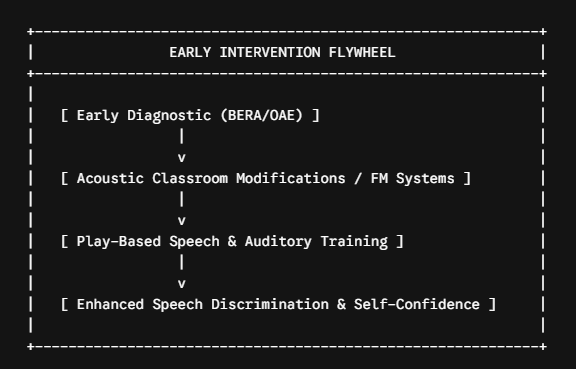
Detecting hidden hearing loss in children is only the beginning. Prompt, structured early intervention prevents academic delays and supports age-appropriate communication skills.
For young children, formal therapy must feel like structured play rather than grueling drills. Play-based speech therapy uses engaging games to strengthen neural processing pathways and auditory discrimination.
Q1. What is the difference between hidden hearing loss and traditional hearing loss?
Traditional hearing loss involves damage to cochlear hair cells, preventing soft sounds from being registered during standard pure-tone audiometry. Hidden hearing loss in children involves damaged neural synapses between hair cells and the auditory nerve; the child hears soft sounds in quiet environments but struggles to process and comprehend speech in noisy settings.
Q2. Can a child pass a standard school hearing test and still have hidden hearing loss?
Yes. School hearing tests rely on pure-tone screening in quiet rooms. Because hidden hearing loss in children preserves pure-tone hearing thresholds, children frequently pass these screenings while continuing to experience severe auditory processing deficits in noisy real-world environments.
Q3. What causes hidden hearing loss in young children?
Causes include early exposure to brief high-intensity noise, recurrent middle ear infections (otitis media) that disrupt sound transmission during critical developmental windows, genetic factors, neonatal jaundice, or mild auditory neuropathy spectrum disorder (ANSD).
Q4. How is hidden hearing loss diagnosed by a pediatric audiologist?
Diagnosis requires objective electrophysiological testing. A pediatric audiologist performs an OAE test to confirm healthy hair cell function, combined with advanced BERA test evaluations to measure neural synchronization along the auditory nerve under varied acoustic conditions.
Q5. Is hidden hearing loss in children permanent?
While damaged neural synapses do not automatically repair themselves, the young brain possesses remarkable neuroplasticity. Targeted play-based speech therapy, auditory training, and assistive acoustic technologies train alternative neural pathways, significantly improving real-world speech discrimination.
Q6. How does hidden hearing loss affect a child’s academic performance?
Classrooms are high-noise environments. A child with hidden hearing loss in children spends excessive cognitive energy filtering out noise, leading to listening fatigue, missed instructional steps, impaired reading/phonics development, and misdiagnoses of ADHD or behavioral non-compliance.
Q7. Are hearing aids beneficial for children with hidden hearing loss?
Standard amplifying hearing aids are rarely useful because volume is not the primary issue. However, specialized low-gain hearing aids with directional microphones, or FM/DM remote microphone systems, significantly improve signal-to-noise ratios, allowing children to hear instructions clearly above classroom background noise.
Q8. How can parents tell if a child has a speech delay or a hearing issue?
A primary speech delay affects spoken language across all settings equally. An auditory issue like hidden hearing loss in children manifests inconsistently—a child understands speech easily in quiet one-on-one settings but experiences significant comprehension breakdown as background noise increases.
Q9. At what age can an objective BERA test or OAE test be performed?
Both OAE test and BERA test procedures are objective—requiring no active behavioral response from the child—and can be performed on newborns, infants, toddlers, and older children.
Q10. How does play-based speech therapy help treat auditory processing problems?
Play-based speech therapy integrates auditory discrimination, phonemic awareness, and sound-in-noise exercises into engaging games. This approach uses playful repetition to stimulate neuroplasticity, strengthening the brain’s ability to decode complex speech signals.
Take Action for Your Child’s Hearing Health
If your child struggles to listen in noisy environments, shows uncharacteristic learning fatigue, or exhibits speech discrimination issues despite passing basic hearing screenings, do not wait. Early identification of hidden hearing loss in children is critical to supporting academic success and emotional well-being.
Experience Universal Accessibility at Your Nearest CC Saha Clinic: Click Here to Book Your Appointment
Speak to an Expert: Call our Toll-Free number 1800 570 9930 (Available Mon-Sat | 10:00 am – 6:30 pm)
Visit CC Saha Ltd.—90 Years of Trust and Excellence.
#cochlearsynaptopathy #OAEtest #BERAtest #speechdiscrimination, #auditoryneuropathy #speechdelayvshearing loss #play-basedspeechtherapy #pediatricaudiologist #CCSahaLtd #HearingLossAwareness #HearingAids #AudiologyCare
We understand how important your sense of hearing is to both you and your family. Our team of professionals is ready to help find the right hearing aid for your individual hearing needs.
An exciting times for hearing aid wearers. Our hearing aids are renowned for high quality sound, famous for quality build and fantastic reliability.
CC Saha provides outstanding service in healthcare network. With innovative technological advancement like invisible protective shield…
Converse easily with your friends, watch your favorite TV shows and navigate safely in traffic with CC Saha’s digital hearing aids….
Hearing screenings can be conducted for every age group. The tests are fairly quick and performed to lower the needs for comprehensive hearing examinations.