Q1. What is the difference between hidden hearing loss and traditional hearing loss?
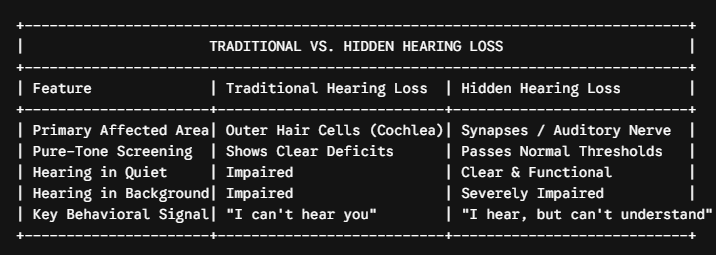
Traditional hearing loss involves damage to cochlear hair cells, preventing soft sounds from being registered during standard pure-tone audiometry. Hidden hearing loss in children involves damaged neural synapses between hair cells and the auditory nerve; the child hears soft sounds in quiet environments but struggles to process and comprehend speech in noisy settings.
Q2. Can a child pass a standard school hearing test and still have hidden hearing loss?
Yes. School hearing tests rely on pure-tone screening in quiet rooms. Because hidden hearing loss in children preserves pure-tone hearing thresholds, children frequently pass these screenings while continuing to experience severe auditory processing deficits in noisy real-world environments.
Q3. What causes hidden hearing loss in young children?
Causes include early exposure to brief high-intensity noise, recurrent middle ear infections (otitis media) that disrupt sound transmission during critical developmental windows, genetic factors, neonatal jaundice, or mild auditory neuropathy spectrum disorder (ANSD).
Q4. How is hidden hearing loss diagnosed by a pediatric audiologist?
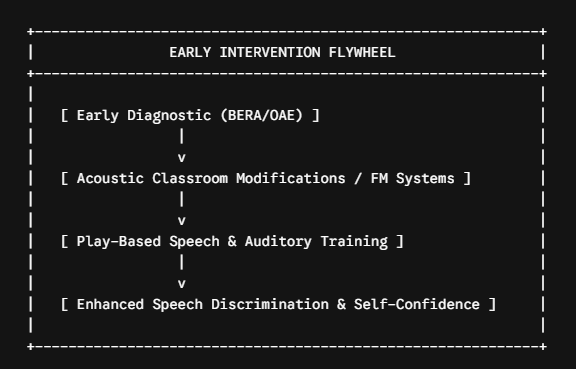
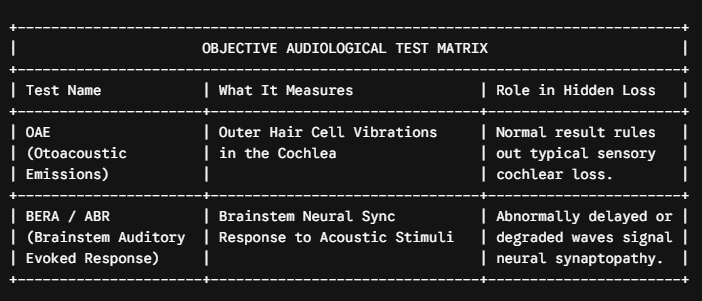
Diagnosis requires objective electrophysiological testing. A pediatric audiologist performs an OAE test to confirm healthy hair cell function, combined with advanced BERA test evaluations to measure neural synchronization along the auditory nerve under varied acoustic conditions.
Q5. Is hidden hearing loss in children permanent?
While damaged neural synapses do not automatically repair themselves, the young brain possesses remarkable neuroplasticity. Targeted play-based speech therapy, auditory training, and assistive acoustic technologies train alternative neural pathways, significantly improving real-world speech discrimination.
Q6. How does hidden hearing loss affect a child’s academic performance?
Classrooms are high-noise environments. A child with hidden hearing loss in children spends excessive cognitive energy filtering out noise, leading to listening fatigue, missed instructional steps, impaired reading/phonics development, and misdiagnoses of ADHD or behavioral non-compliance.
Q7. Are hearing aids beneficial for children with hidden hearing loss?
Standard amplifying hearing aids are rarely useful because volume is not the primary issue. However, specialized low-gain hearing aids with directional microphones, or FM/DM remote microphone systems, significantly improve signal-to-noise ratios, allowing children to hear instructions clearly above classroom background noise.
Q8. How can parents tell if a child has a speech delay or a hearing issue?
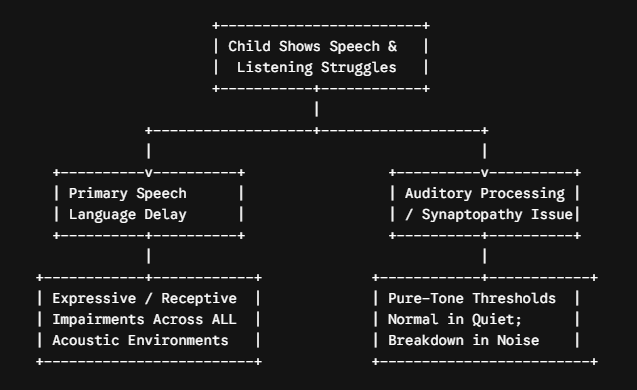
A primary speech delay affects spoken language across all settings equally. An auditory issue like hidden hearing loss in children manifests inconsistently—a child understands speech easily in quiet one-on-one settings but experiences significant comprehension breakdown as background noise increases.
Q9. At what age can an objective BERA test or OAE test be performed?
Both OAE test and BERA test procedures are objective—requiring no active behavioral response from the child—and can be performed on newborns, infants, toddlers, and older children.
Q10. How does play-based speech therapy help treat auditory processing problems?
Play-based speech therapy integrates auditory discrimination, phonemic awareness, and sound-in-noise exercises into engaging games. This approach uses playful repetition to stimulate neuroplasticity, strengthening the brain’s ability to decode complex speech signals.