Q1. Why do hearing aids sound distorted when I listen to live music?
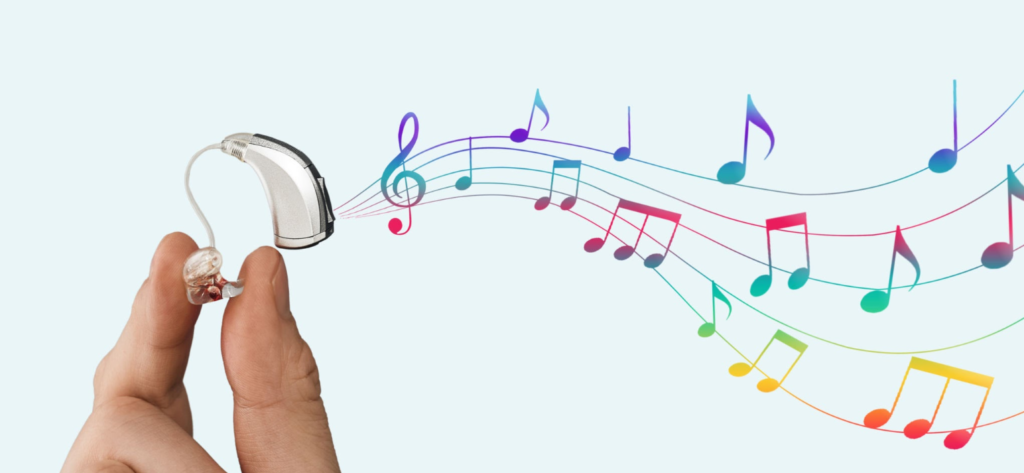
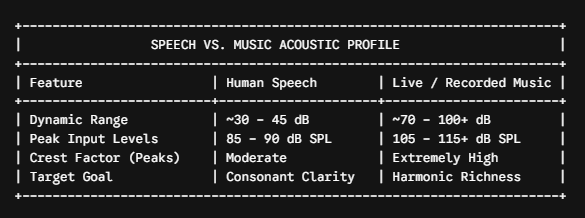
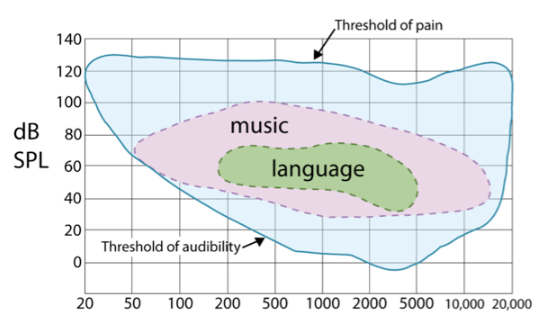
Legacy hearing aids experience distortion during live music because their internal microphones and Analog-to-Digital Converters (ADCs) are capped at lower decibel thresholds designed for speech (around 85–95 dB SPL). When live music exceeds these levels, peak input level clipping occurs before the sound can be processed. Modern hearing aids for listening to music use high-headroom ADCs that handle up to 118 dB SPL without distortion.
Q2. What is the difference between a speech program and a hearing aid music program?
A speech program prioritizes consonant clarity by using fast dynamic compression, directional microphones, ambient noise suppression, and active feedback cancellation. A dedicated hearing aid music program removes aggressive compression, disables noise reduction, uses omnidirectional microphone pick-up, and modifies feedback rules so sustained musical notes remain pure and natural.
Q3. Can I play a musical instrument while wearing modern hearing aids?
Yes, musicians can comfortably play instruments while wearing modern hearing aids. Your audiologist at CC Saha Ltd. can create a customized musician preset that compensates for the high sound pressure generated near your ear or instrument, ensuring clear feedback-free monitoring and accurate pitch perception.
Q4. Why does a flute or violin sound like a vibrato or warbling tone through my hearing aid?
Warbling tones occur when a hearing aid’s automatic feedback cancellation system misidentifies a clean, sustained musical note (like a flute or violin tone) as internal feedback whistling. The device attempts to cancel the note using phase inversion, creating an unwanted artificial vibrato. Switching to a dedicated music program disables this aggressive cancellation algorithm.
Q5. Are open fit domes or closed earpieces better for hearing aid music sound quality?
The choice between open and closed fitting depends on your personal hearing loss profile. Open fit domes allow natural bass frequencies to enter the ear canal directly, creating a rich soundscape for mild-to-moderate high-frequency loss. However, for moderate-to-severe losses, closed custom earpieces retain low-frequency bass energy generated by the hearing aid speakers.
Q6. How do I find the best hearing aids for listening to music?
The best hearing aids for listening to music feature a wide dynamic input range (at least 110 dB SPL peak limit), high sampling frequency, multi-channel linear processing, customizable equalizer settings, and dedicated music programs validated through Real-Ear Measurement (REM).
Q7. Does Bluetooth streaming improve hearing aid music sound quality compared to room acoustic listening?
Bluetooth streaming delivers direct, pristine audio signals from your smartphone or media player straight into the hearing aid processors. This bypasses room reverberation, ambient background noise, and acoustic distance losses, offering exceptional clarity for recorded music, though live concerts still rely on acoustic microphone performance.
Q8. Why does recorded music sometimes sound thin or lacking bass through amplification?
Hearing aids feature small receivers (speakers) optimized for high-frequency speech clarity rather than subwoofer-style bass. If your earpieces have large acoustic vents, low-frequency bass leaks out before reaching your eardrum. Adjusting vent sizing or boosting low-frequency gain in your music program restores warm, resonant bass tones.
Q9. Is Wide Dynamic Range Compression (WDRC) good or bad for music listening?
Aggressive WDRC designed for speech is generally detrimental to music because it squashes dynamic contrasts—making quiet passages unnaturally loud and loud passages compressed. Music programs utilize lower compression ratios or linear amplification to preserve the artist’s intended dynamic range.
Q10. How can CC Saha Ltd. help me optimize my hearing aids for music appreciation?
CC Saha Ltd. provides expert audiological fittings using advanced Real-Ear Measurement (REM) equipment, customized music program tuning, earpiece selection, and personalized acoustic counseling. Our clinical specialists tailor every device to match your personal listening habits, musical preferences, and lifestyle needs.