Invisible Hearing Aids
CC Saha provides outstanding service in healthcare network. With innovative technological advancement like invisible protective shield…
Hearing loss rarely arrives with a sudden single shift; for millions of individuals across the world, it begins as a gradual fading of everyday acoustics. When progressive or sudden severe-to-profound sensorineural hearing loss occurs after speech and language have already been fully acquired, the condition is clinically termed post-lingual deafness. For these individuals, the silence is not an native canvas—it is a sudden disruption to a life built around acoustic communication, ambient music, spoken laughter, and effortless social connection.
Fortunately, modern medical technology and advanced clinical audiology have transformed what was once considered permanent adult silence. Cochlear implants for post-lingually deaf adults represent one of the most successful neural prosthetic interventions in modern medicine. Unlike traditional hearing aids that simply amplify sound pressure waves into an injured inner ear, a cochlear implant completely bypasses damaged hair cells within the cochlea, directly stimulating the auditory nerve with precisely encoded electrical signals.
However, receiving the surgical implant is only the first step of a transformative journey. Relearning how to hear later in life requires patience, specialized auditory rehabilitation for severe hearing loss, and an understanding of neuroplasticity and auditory cortex adaptation. This comprehensive guide from Audiology Avenue by C.C. Saha Ltd. explores the clinical evidence, cognitive benefits, auditory mapping processes, and realistic timelines associated with cochlear implants for post-lingually deaf adults.
Post-lingual hearing loss occurs in individuals who developed normal speech and language skills prior to experiencing profound auditory impairment. Common etiologies include progressive otosclerosis, Meniere’s disease, acoustic trauma, ototoxic medication exposure, genetic conditions, head trauma, and age-related presbycusis.
HEARING AID:
Sound Input —> Acoustic Amplifier —> Damaged Cochlear Hair Cells —> Nerve
(Limited benefit if hair cells are non-functional)
COCHLEAR IMPLANT:
Sound Input —> Processor & Transmitter —> Internal Array —> Auditory Nerve
(Bypasses damaged hair cells entirely via direct electrical stimulation)
When acoustic amplification via traditional hearing aids no longer yields sufficient speech clarity, individuals experience severe acoustic isolation. Prolonged sound deprivation causes the brain’s central auditory pathways to undergo degradation. Clinical research demonstrates that extended periods without acoustic input lead to auditory deprivation, where the brain’s processing efficiency decreases over time.
This makes timely clinical evaluation critical. When evaluating cochlear implants for deaf adults, audiologists assess open-set speech recognition scores using amplified sentence tests. When optimal hearing aid fitting fails to achieve more than 50% to 60% sentence comprehension in the ear to be implanted, post-lingual cochlear implantation becomes the primary recommended treatment pathway.
A common misconception among mature individuals experiencing late-onset deafness hearing solutions is that an adult brain is too rigid to adapt to synthetic auditory inputs. Clinical neuroscience proves the exact opposite: the human brain retains remarkable capacity for neuroplastic adaptation throughout entire adulthood.
When cochlear implants for post-lingually deaf adults are activated, the recipient does not immediately hear rich, natural acoustic sounds. Instead, the brain receives novel electrical impulses delivered across an electrode array inserted into the scala tympani of the cochlea. Initially, these signals may sound metallic, robotic, or squeaky.
STAGE 1: SIGNAL DETECTION– Brain registers raw electrical pulses from processor
STAGE 2: PATTERN MATCHING– Auditory cortex aligns signals with memory banks
STAGE 3: SPEECH INTEGRATION– Electrical patterns convert into intelligible words
STAGE 4: AUTOMATICITY– Listening becomes effortless and natural again
This is where the pre-existing language framework of post-lingually deaf individuals serves as a major biological advantage. Because their brain has stored acoustic neural networks, memories of phonemes, words, and speech cadences, it works rapidly to map new electrical patterns onto existing memory templates. Through consistent daily wear and targeted speech-language therapy for adults, the auditory cortex reinterprets electrical signals into clear, recognizable voices and environmental sounds.
The outcomes of cochlear implants for post-lingually deaf adults vary across individuals, but decades of clinical data identify clear prognostic variables determining speech recognition success.
PROGNOSTIC VARIABLE & POSITIVE IMPACT ON SPEECH RECOGNITION
Duration of Deafness- Shorter duration (< 10 years) preserves spiral ganglion
Pre-Implant Speech Score- Higher baseline speech scores indicate active pathways
Wear Time & Rehabilitation- > 12 hours daily processor wear accelerates brain mapping
Cognitive Reserve- Strong verbal learning memory enhances context cues
Residual Hearing- Preserved low-frequency hearing aids natural quality
Research systematically indicates that the duration of deafness is one of the strongest individual predictors of post-implantation speech perception scores. Adults who seek intervention soon after severe-to-profound hearing loss occurs achieve faster speech comprehension gains than those who remain in total acoustic deprivation for decades. Prolonged deprivation leads to neural degeneration of spiral ganglion cells within the inner ear; early intervention preserves these vital nerve structures.
Recent long-term clinical studies demonstrate that biological age alone is not a limiting factor for successful outcomes. Healthy older adults in their 70s, 80s, and even 90s show dramatic improvements in open-set speech recognition, environmental sound awareness, and overall health-related quality of life matching those of younger adults.
Cognitive performance, specifically verbal learning and working memory capacity, plays a central role in how adults process transformed auditory inputs. Standardized tests like the California Verbal Learning Test (CVLT-II) show that post-lingually deaf adults who receive implants experience measurable benefits in verbal memory retention. By relieving the severe cognitive load previously spent on strain-filled lipreading and sound guessing, adult cochlear implant candidacy and recovery allows cognitive resources to return to memory encoding and active conversation processing.
When addressing severe-to-profound post-lingual hearing loss, clinical audiologists evaluate whether a patient benefits most from unilateral (one ear), bimodal (a cochlear implant in one ear and a hearing aid in the opposite ear), or bilateral vs unilateral implantation (cochlear implants in both ears).
UNILATERAL IMPLANT– Restores sound perception to one ear; good for basic quiet; speech, but limited spatial localization.
BIMODAL SYSTEM – Implant in one ear + Hearing Aid in other; optimizes; residual low-frequency acoustic hearing and balance.
BILATERAL IMPLANTS– Implants in both ears; delivers maximum sound localization; superior speech understanding in noisy environments.
The journey toward relearning how to hear later in life through cochlear implants for post-lingually deaf adults follows a structured multi-disciplinary protocol designed to ensure surgical safety and long-term performance.
STEP 1: Comprehensive Audiological Evaluation & High-Resolution Imaging (CT/MRI)
STEP 2: Outpatient Surgical Placement of Electrode Array & Receiver-Stimulator
STEP 3: Initial System Activation & Custom Sound Processor Mapping (3-4 Wks Post-Op)|
STEP 4: Structured Auditory Rehabilitation & Speech-Language Therapy
STEP 5: Fine-Tuning Fitting Sessions & Long-Term Performance Monitoring
Candidates undergo comprehensive evaluations, including high-resolution CT/MRI scans to confirm cochlear anatomy, speech perception testing in quiet and noisy environments, and medical clearance.
The surgical implantation is a routine, low-risk procedure performed under general anesthesia. The surgeon creates a minimal incision behind the ear, anchors the internal receiver-stimulator beneath the skin, and gently inserts the flexible electrode array into the cochlea. Patients typically return home the same day or following a brief overnight stay.
Approximately three to four weeks following surgery, once surgical healing is complete, the patient returns to the clinic for initial activation. The audiologist connects the external processor and performs meticulous sound processor mapping, setting dynamic range thresholds (T-levels) and maximum comfort levels (C-levels) for every individual electrode channel.
Activation marks the beginning of active training. Auditory rehabilitation for severe hearing loss incorporates listening exercises, audiobooks paired with text reading, app-based listening software, and structured acoustic practice to help the brain master complex sound discrimination.
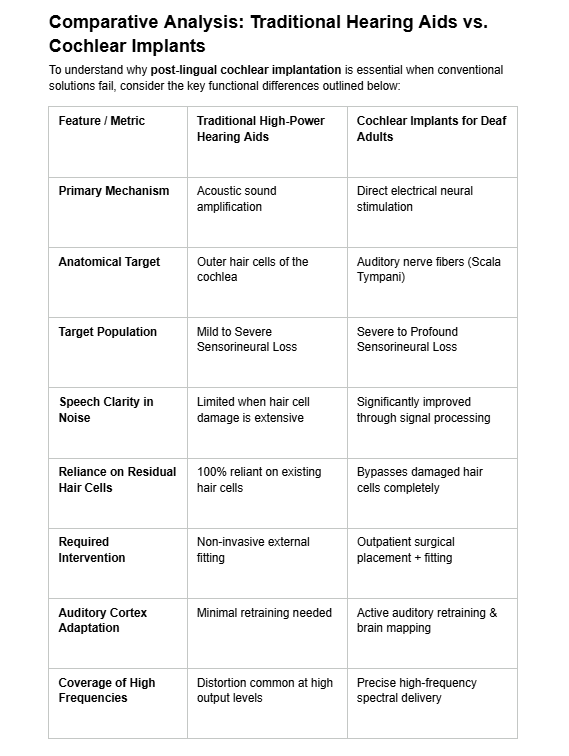
To understand why post-lingual cochlear implantation is essential when conventional solutions fail, consider the key functional differences outlined below:
EXCELLENTTrustindex verifies that the original source of the review is Google. Best servicePosted onTrustindex verifies that the original source of the review is Google. All type of hearing aids are availablePosted onTrustindex verifies that the original source of the review is Google. A trusted and familiar hearing aids clinicPosted onTrustindex verifies that the original source of the review is Google. Signia best h/aidPosted onTrustindex verifies that the original source of the review is Google. Signia best hearing aidPosted onTrustindex verifies that the original source of the review is Google. Signia best hearing aidPosted onTrustindex verifies that the original source of the review is Google. A range of hearing aids are availablePosted onTrustindex verifies that the original source of the review is Google. Very fast and prompt service......liked itPosted onTrustindex verifies that the original source of the review is Google. Hearing machine in good condition, staff is good and polite.Posted onTrustindex verifies that the original source of the review is Google. Best hearing aidsVerified by TrustindexTrustindex verified badge is the Universal Symbol of Trust. Only the greatest companies can get the verified badge who has a review score above 4.5, based on customer reviews over the past 12 months. Read more
Adult candidacy is determined through comprehensive audiological evaluations. Candidates typically have severe-to-profound sensorineural hearing loss in both ears and receive limited benefit from correctly fitted hearing aids, defined as scoring 50% or less on open-set sentence recognition tests in the ear to be implanted (or 60% or less in the best-aided condition). Medical evaluation and imaging must also confirm that the auditory nerve and cochlear structures are healthy enough for implantation.
Relearning to hear relies on the brain’s neuroplasticity. Because post-lingually deaf adults already possess established language memories and auditory neural pathways, the brain acts like a decoding system. Over weeks and months of daily processor use and structured auditory rehabilitation, the auditory cortex learns to match novel electrical impulses sent by the implant array to known words, tones, and environmental sounds.
No. At initial activation, voices often sound high-pitched, robotic, metallic, or cartoon-like. This is completely normal because the electrical signals differ from natural mechanical acoustic waves. As the user wears the sound processor daily and attends follow-up sound processor mapping sessions, the brain adapts, causing voices to sound increasingly natural, clear, and distinct over 3 to 6 months.
Age alone is not a barrier to successful implantation. Research shows that healthy adults in their 70s, 80s, and 90s achieve speech perception gains and quality-of-life improvements comparable to younger recipients. Factors such as general medical fitness, active processor wear time, and cognitive engagement are far more predictive of outcome success than chronological age.
A shorter duration of deafness generally correlates with faster auditory recovery and higher speech recognition scores. Long-term sound deprivation leads to gradual auditory deprivation and neural spiral ganglion cell loss. However, even individuals with extended periods of hearing loss experience meaningful improvements in environmental sound awareness, sound localization, and speech understanding when supported by structured rehabilitation.
Bimodal hearing utilizes a cochlear implant in one ear and a traditional hearing aid in the opposite ear, optimizing both direct electrical stimulation and acoustic low-frequency residual hearing. Bilateral cochlear implantation involves placing implants in both ears, which provides balanced binaural hearing cues, superior sound localization in 3D space, and improved speech clarity in noisy settings.
The surgical procedure itself is typically an outpatient process with physical healing occurring over 2 to 4 weeks. Soft tissue recovery is generally mild with minimal discomfort. The true auditory recovery—the process of training the brain to interpret electrical hearing—takes place over 3 to 12 months through consistent daily wear, processor adjustments, and auditory exercises.
Yes, though music perception requires more time and targeted practice than speech recognition. Because music involves complex pitch structures, harmonics, and timbre, implants excel at rhythm and tempo but can initially make melody recognition challenging. Specialized music rehabilitation programs and advanced processor settings significantly enhance musical enjoyment over time.
Clinical research utilizing cognitive instruments like the CVLT-II demonstrates that cochlear implants for post-lingually deaf adults help restore cognitive capacity. By eliminating the severe strain of lipreading and acoustic guessing, cognitive resources are freed up, leading to measurable improvements in working memory, verbal learning, sustained attention, and social engagement.
Auditory rehabilitation provides structured exercises that guide the brain through sound discrimination, speech tracking, and listening in background noise. Just as physical therapy is essential to regain movement after joint surgery, auditory training accelerates cortical adaptation, ensuring recipients achieve the highest possible speech perception and conversational confidence.
Reclaim your connection to the world of sound.
Later-life hearing loss doesn’t have to define your world. Whether you’re exploring cochlear implants for post-lingually deaf adults for yourself or a loved one, expert guidance makes all the difference in your auditory journey.
Experience Universal Accessibility at Your Nearest CC Saha Clinic: Click Here to Book Your Appointment
Speak to an Expert: Call our Toll-Free number 1800 570 9930 (Available Mon-Sat | 10:00 am – 6:30 pm)
Visit CC Saha Ltd.—90 Years of Trust and Excellence.
#CochlearImplantsForPostLinguallyDeafAdults #AudiologyAvenue #CCSahaLtd #AdultHearingLoss #CochlearImplants #AuditoryRehabilitation #HearingHealth #DeafnessToSound #Neuroplasticity #SpeechPerception #HearingLossAwareness #HearingAids #AudiologyCare
CC Saha provides outstanding service in healthcare network. With innovative technological advancement like invisible protective shield…
Converse easily with your friends, watch your favorite TV shows and navigate safely in traffic with CC Saha’s digital hearing aids….
Hearing screenings can be conducted for every age group. The tests are fairly quick and performed to lower the needs for comprehensive hearing examinations.