Q1. What makes someone a candidate for cochlear implants for post-lingually deaf adults?
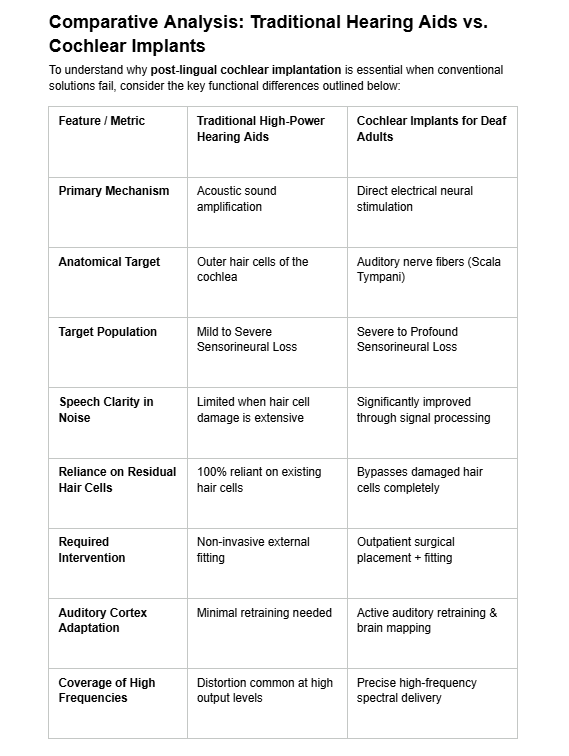
Adult candidacy is determined through comprehensive audiological evaluations. Candidates typically have severe-to-profound sensorineural hearing loss in both ears and receive limited benefit from correctly fitted hearing aids, defined as scoring 50% or less on open-set sentence recognition tests in the ear to be implanted (or 60% or less in the best-aided condition). Medical evaluation and imaging must also confirm that the auditory nerve and cochlear structures are healthy enough for implantation.
Q2. How does relearning how to hear later in life actually work after surgery?
Relearning to hear relies on the brain’s neuroplasticity. Because post-lingually deaf adults already possess established language memories and auditory neural pathways, the brain acts like a decoding system. Over weeks and months of daily processor use and structured auditory rehabilitation, the auditory cortex learns to match novel electrical impulses sent by the implant array to known words, tones, and environmental sounds.
Q3. Will voices sound natural immediately upon activation of the implant?
No. At initial activation, voices often sound high-pitched, robotic, metallic, or cartoon-like. This is completely normal because the electrical signals differ from natural mechanical acoustic waves. As the user wears the sound processor daily and attends follow-up sound processor mapping sessions, the brain adapts, causing voices to sound increasingly natural, clear, and distinct over 3 to 6 months.
Q4. Does age limit the success of post-lingual cochlear implantation in elderly adults?
Age alone is not a barrier to successful implantation. Research shows that healthy adults in their 70s, 80s, and 90s achieve speech perception gains and quality-of-life improvements comparable to younger recipients. Factors such as general medical fitness, active processor wear time, and cognitive engagement are far more predictive of outcome success than chronological age.
Q5. How does the duration of deafness impact post-implant speech recognition performance?
A shorter duration of deafness generally correlates with faster auditory recovery and higher speech recognition scores. Long-term sound deprivation leads to gradual auditory deprivation and neural spiral ganglion cell loss. However, even individuals with extended periods of hearing loss experience meaningful improvements in environmental sound awareness, sound localization, and speech understanding when supported by structured rehabilitation.
Q6. What is the difference between bimodal hearing and bilateral cochlear implantation?
Bimodal hearing utilizes a cochlear implant in one ear and a traditional hearing aid in the opposite ear, optimizing both direct electrical stimulation and acoustic low-frequency residual hearing. Bilateral cochlear implantation involves placing implants in both ears, which provides balanced binaural hearing cues, superior sound localization in 3D space, and improved speech clarity in noisy settings.
Q7. How long does the recovery process take after cochlear implant surgery?
The surgical procedure itself is typically an outpatient process with physical healing occurring over 2 to 4 weeks. Soft tissue recovery is generally mild with minimal discomfort. The true auditory recovery—the process of training the brain to interpret electrical hearing—takes place over 3 to 12 months through consistent daily wear, processor adjustments, and auditory exercises.
Q8. Can post-lingually deaf adults listen to music with a cochlear implant?
Yes, though music perception requires more time and targeted practice than speech recognition. Because music involves complex pitch structures, harmonics, and timbre, implants excel at rhythm and tempo but can initially make melody recognition challenging. Specialized music rehabilitation programs and advanced processor settings significantly enhance musical enjoyment over time.
Q9. How do cognitive functions like verbal memory change after receiving a cochlear implant?
Clinical research utilizing cognitive instruments like the CVLT-II demonstrates that cochlear implants for post-lingually deaf adults help restore cognitive capacity. By eliminating the severe strain of lipreading and acoustic guessing, cognitive resources are freed up, leading to measurable improvements in working memory, verbal learning, sustained attention, and social engagement.
Q10. Why is professional auditory rehabilitation necessary after fitting the implant?
Auditory rehabilitation provides structured exercises that guide the brain through sound discrimination, speech tracking, and listening in background noise. Just as physical therapy is essential to regain movement after joint surgery, auditory training accelerates cortical adaptation, ensuring recipients achieve the highest possible speech perception and conversational confidence.