Paediatric Hearing Care
Early intervention is the key to paediatric hearing care. Learn how CC Saha Ltd. combines audiology, speech therapy, and occupational therapy for success.
When a recipient’s device is turned on during activation day, families often anticipate an immediate breakthrough—expecting the user to instantly comprehend spoken words and converse effortlessly. However, activation is merely the starting line of a multi-stage journey. Providing access to sound is only half the solution; the brain must learn how to process, interpret, and assign meaning to those acoustic signals.
Understanding why speech therapy after cochlear implant surgery is indispensable requires examining how the human auditory cortex responds to new electrical inputs. At CC Saha Ltd.’s Audiology Avenue, our clinical experience confirms that hardware and mapping represent only 50% of successful hearing rehabilitation. The remaining 50% relies on structured speech therapy after cochlear implant activation, specifically through specialized techniques like Auditory Verbal Therapy (AVT).
To understand why speech therapy after cochlear implant fittings is necessary, it helps to distinguish between hearing sound and processing language.
A naturally functioning biological ear uses tiny hair cells in the cochlea to translate mechanical sound waves into complex fluid vibrations. These vibrations trigger thousands of delicate neural pathways that send rich, nuanced signals to the brain.
In contrast, a cochlear implant bypasses damaged inner ear hair cells entirely. It uses an external processor to capture acoustic energy, convert it into digital data, and send electrical pulses through an internal electrode array directly to the auditory nerve.
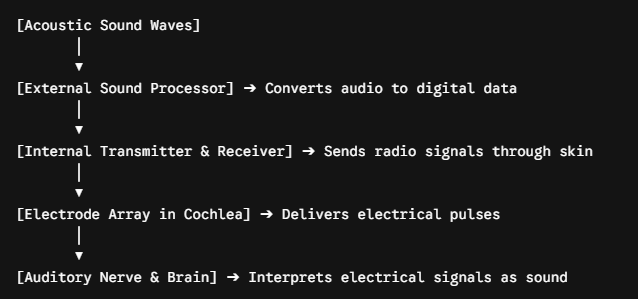
While this technology is remarkable, electrical stimulation differs significantly from natural acoustic hearing:
Audiological mapping (or programming) is the process where an audiologist calibrates the processor’s electrical current. The clinician sets two primary levels for each electrode band:
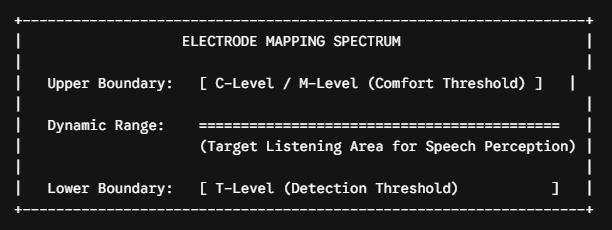
Proper mapping ensures that sound signals fit comfortably within the recipient’s dynamic range. However, mapping only adjusts the volume and delivery of signals—it does not teach the brain how to interpret them.
Without structured speech therapy after cochlear implant programming, an individual may hear sound impulses without understanding what they mean. A child might hear a door slam, a dog bark, or their mother calling their name, but without targeted post cochlear implant auditory habilitation, these sounds remain unorganized background noise.
Once surgical healing is complete and initial device mapping is established, the critical work of auditory rehabilitation begins. The primary therapeutic approach used for young children receiving implants is Auditory Verbal Therapy (AVT).
The human brain possesses neuroplasticity—the ability to reorganize neural pathways in response to new sensory experiences. When an individual suffers from severe-to-profound hearing loss, the brain’s auditory cortex can lie understimulated. In young children, if auditory pathways are not stimulated during the critical early years (0 to 3 years old), the brain may reassign those unused cortical areas to visual processing.
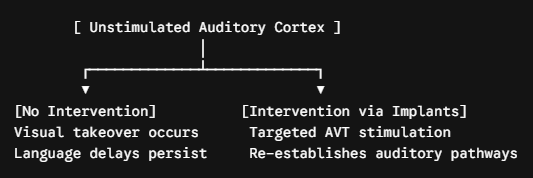
Commencing speech therapy after cochlear implant activation leverages this window of neuroplasticity. Structured auditory training encourages the brain to build new neural connections dedicated to decoding electrical pulses. Through repeated exposure and guided practice, the auditory cortex learns to convert raw acoustic signals into recognizable phonemes, words, and full sentences.
Auditory Verbal Therapy is an evidence-based, specialized approach designed to teach children with hearing loss to listen and speak using their amplified hearing. Unlike traditional speech therapy methods that may rely heavily on lip-reading, visual cues, or sign language, AVT focuses directly on the auditory channel.
Key principles of AVT include:
Through targeted speech therapy after cochlear implant placement, recipients progress through four established stages of auditory skill development:
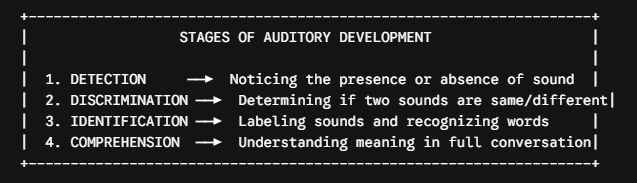
The foundational stage involves helping the recipient recognize whether a sound is present or absent. Exercises focus on basic awareness, such as conditioning a child to drop a toy block into a bucket whenever they hear a sound (e.g., the “Ling Six Sound Test”: /a/, /u/, /i/, /s/, /sh/, /m/).
Once sound detection is reliable, therapy moves to identifying differences between acoustic signals. The user learns to distinguish between long and short sounds, loud and soft tones, high and low pitches, or words with varying syllable counts (e.g., “cat” vs. “banana”).
In this phase, the recipient learns to associate specific sound patterns with concrete objects or actions. The individual learns to identify items based solely on their spoken names or acoustic properties without visual prompts (e.g., selecting a toy train when hearing “choo-choo”).
The final stage focuses on understanding complex, connected spoken language in real-world environments. The user practices answering questions, following multi-step instructions, and holding conversations in noisy settings like classrooms or social gatherings.
Therapy sessions with a certified Speech-Language Pathologist (SLP) or Listening and Spoken Language Specialist (LSLS) typically occur once or twice a week. However, true skill development happens during everyday life. Parents and caregivers play an essential role in implementing cochlear implant speech therapy exercises at home.
Here are research-backed, practical strategies parents can use to maximize the benefits of speech therapy after cochlear implant activation:
Auditory sandwiching is a technique designed to prioritize listening while providing support when needed:

Turn everyday activities like cooking, dressing, or bath time into language-rich environments:
Acoustic highlighting involves subtly adjusting your voice to make key target words easier for the brain to detect and process:
During designated practice times:
EXCELLENTTrustindex verifies that the original source of the review is Google. Best servicePosted onTrustindex verifies that the original source of the review is Google. All type of hearing aids are availablePosted onTrustindex verifies that the original source of the review is Google. A trusted and familiar hearing aids clinicPosted onTrustindex verifies that the original source of the review is Google. Signia best h/aidPosted onTrustindex verifies that the original source of the review is Google. Signia best hearing aidPosted onTrustindex verifies that the original source of the review is Google. Signia best hearing aidPosted onTrustindex verifies that the original source of the review is Google. A range of hearing aids are availablePosted onTrustindex verifies that the original source of the review is Google. Very fast and prompt service......liked itPosted onTrustindex verifies that the original source of the review is Google. Hearing machine in good condition, staff is good and polite.Posted onTrustindex verifies that the original source of the review is Google. Best hearing aidsVerified by TrustindexTrustindex verified badge is the Universal Symbol of Trust. Only the greatest companies can get the verified badge who has a review score above 4.5, based on customer reviews over the past 12 months. Read more
While a cochlear implant provides access to sound, it sends electrical signals rather than biological acoustic impulses to the auditory nerve. The brain does not automatically know how to interpret these signals into recognizable speech. Speech therapy after cochlear implant surgery trains the brain’s auditory cortex to decode these electrical patterns, convert them into meaningful language, and build clear speech production skills.
Standard speech therapy often addresses overall communication, articulation, and motor speech skills, sometimes incorporating visual aids, lip-reading, or gestures. Auditory Verbal Therapy (AVT) is a specialized approach designed specifically for children with hearing loss who use hearing technology like cochlear implants. AVT focuses exclusively on developing listening skills through the auditory channel alone—without relying on lip-reading or sign language—so the child learns to process sound naturally.
Rehabilitation should begin immediately after device activation—typically 2 to 4 weeks after the surgical procedure. Starting speech therapy after cochlear implant activation right away takes advantage of peak brain neuroplasticity, ensuring the user begins building auditory pathways as soon as sound input is restored.
The duration of therapy varies based on the recipient’s age at implantation, duration of hearing loss prior to surgery, consistency of device use, and home practice habits. Children implanted early typically receive structured therapy for 2 to 4 years to reach age-appropriate listening and language benchmarks. Adults usually undergo a few months to a year of targeted auditory rehabilitation to adapt to their new sound input.
Adults benefit significantly from post-implant speech therapy and auditory training. While children focus on language acquisition, adults use auditory rehabilitation to retrain their brain to recognize speech patterns through the electrical signal. This helps accelerate word recognition, improves conversation skills in noisy settings, and reduces the learning curve associated with new implant hardware.
Without structured therapy, a child may struggle to make sense of the sound signals delivered by their implant processor. They might detect environmental sounds but struggle to understand spoken language, express themselves clearly, or develop normal speech patterns. This can lead to persistent speech delays, difficulties in school, and challenges with social interaction.
The Ling Six Sound Test consists of six specific speech sounds—/a/, /u/, /i/, /s/, /sh/, /m/—that span the low, middle, and high frequency ranges of human speech. Therapists and parents use this quick check to verify that the cochlear implant user can detect sounds across the full speech spectrum. Performing this test daily ensures the device processor is working properly and mapped correctly.
Progress is measured through standardized speech perception tests, developmental auditory milestone checklists, and ongoing clinical evaluations with a speech-language pathologist. Parents can track day-to-day progress by observing whether their child responds to their name without visual cues, turns toward soft environmental sounds, imitates vocalizations, and begins following simple spoken directions at home.
For optimal brain development and auditory learning, the processor should be worn during all waking hours—typically 12 to 14 hours per day. Consistent wear provides the auditory cortex with a continuous stream of sound, which is essential for building strong neural pathways and making steady progress in therapy.
Parent involvement is essential because children spend far more time at home than in weekly clinical appointments. AVT coaches parents to integrate auditory learning into daily activities like meals, play, and bedtime routines. Consistent, real-world listening opportunities throughout the day help children practice and reinforce the skills learned in therapy.
Partnering with CC Saha Ltd. for Lifelong Hearing Success!
Receiving a cochlear implant is a transformative milestone, but the device processor is only the first step toward clear communication. Achieving meaningful speech comprehension and fluent expression requires a dedicated commitment to rehabilitation. Commencing speech therapy after cochlear implant activation bridge the gap between hearing electrical signals and understanding spoken language.
Visit Audiology Avenue or contact CC Saha Ltd. today to schedule a consultation with our experienced audiologists and speech-language specialists.
Experience Universal Accessibility at Your Nearest CC Saha Clinic: Click Here to Book Your Appointment
Speak to an Expert: Call our Toll-Free number 1800 570 9930 (Available Mon-Sat | 10:00 am – 6:30 pm)
Visit CC Saha Ltd.—90 Years of Trust and Excellence.
#CochlearImplant #SpeechTherapy #AuditoryVerbalTherapy #HearingLoss #Audition #SpeechPathology #HearingRehabilitation #CCSahaLtd #AudiologyAvenue #HearingHealth
Early intervention is the key to paediatric hearing care. Learn how CC Saha Ltd. combines audiology, speech therapy, and occupational therapy for success.
As we welcome 2026, it is time to prioritize ear health. Explore our guide on making impactful hearing resolutions for the New Year, from annual testing to upgrading your devices.

At CC Saha Ltd., excellence in hearing care meets a legacy of compassion and expertise. As the best hearing aid centre in Kolkata since 1933, the brand continues to make hearing comfortable, easy, and life-changing for every generation.

CC Saha Ltd delivers the best cochlear implants in Kolkata and Eastern India, specializing in various types and guiding patients through every stage of the cochlear implant journey.

Early detection of hearing loss can define a child’s ability to communicate, learn, and connect with the world. Paediatric hearing tests are designed to identify hearing challenges at the earliest stages, often before a parent even notices a concern. From new-born OAE and ABR screenings to playful conditioned audiometry in toddlers, these specialized tests ensure accurate results in a child-friendly way.
The benefits of hearing aids go far beyond better hearing—they transform lives by improving communication, emotional health, and cognitive vitality. From reconnecting with loved ones to regaining confidence in social and professional settings, hearing aids restore the joy of sound in every moment. With advanced technology that adapts to individual environments, they offer clarity, comfort, and control. Discover how embracing modern hearing solutions through CC Saha Ltd. can help you experience the life-changing benefits of hearing aids today.