Brilliant Sound Galaxy
Signia’s Brilliant Sound Galaxy in Kolkata at C.C. Saha Ltd. BSG offering a revolutionary hearing experience with immersive sound domes, AR demos, and personalized care.
The classic pure-tone audiogram is the cornerstone of modern hearing care. For decades, sitting in a soundproof booth, wearing headphones, and raising your hand at the faint sound of a beep has provided an elegant map of human hearing. But what happens when a patient cannot raise their hand?
How do we accurately plot a hearing threshold for a two-week-old infant, an uncooperative toddler, an individual with severe developmental delays, or someone suspected of malingering (faking a hearing loss)? Furthermore, what happens when the hearing issue originates deep within the auditory nerve pathways rather than the inner ear itself?
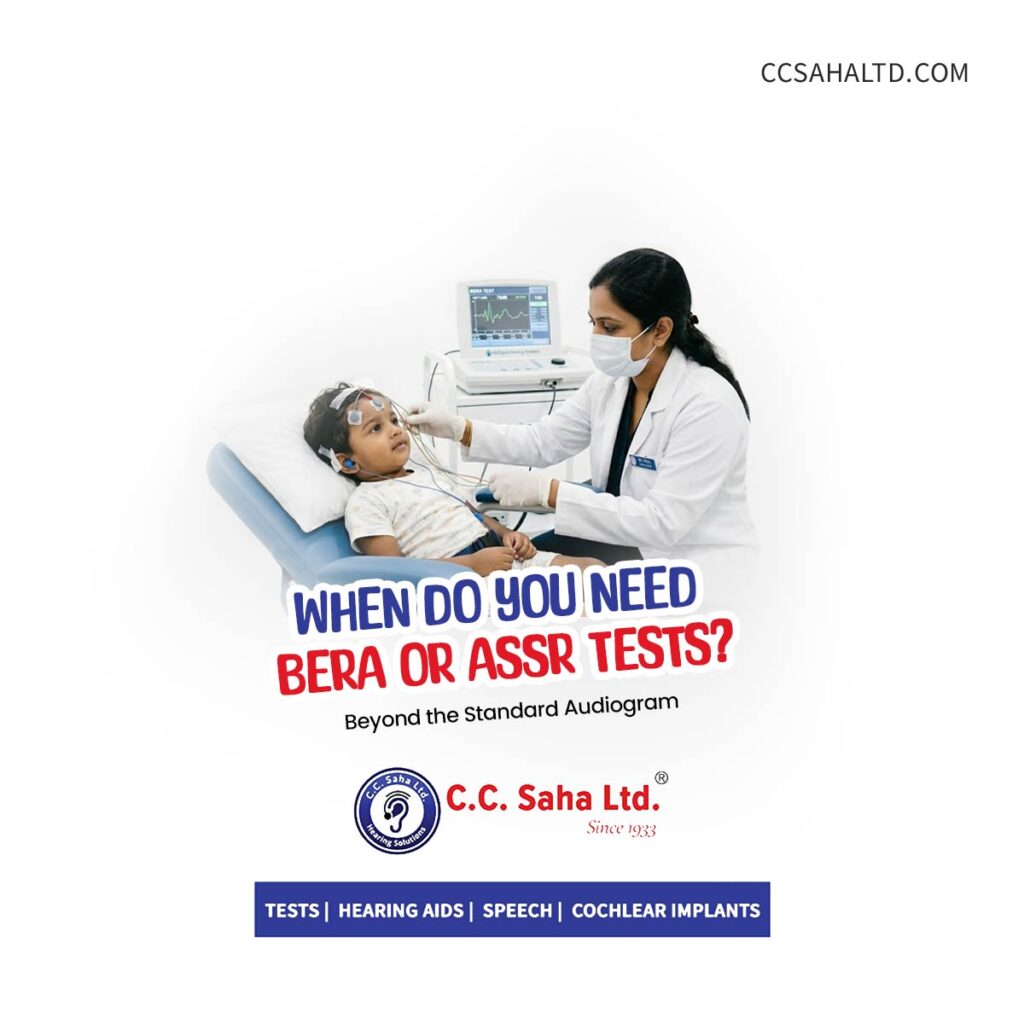
This is where standard behavioural testing reaches its structural limits. To close this diagnostic gap, modern clinical audiology utilizes objective, electrophysiological assessments. If you or a loved one has been referred for advanced testing, this comprehensive guide, When Do You Need a BERA or ASSR Test? will clarify the science, clinical indications, and unique advantages behind these advanced diagnostic tools.
To understand why advanced testing is required, we must analyse how a traditional pure-tone audiogram operates. Behavioural audiometry is subjective—it requires an unbroken loop of communication: the machine delivers a sound, the patient’s ear collects it, the brain consciously processes it, and the patient executes a physical action (pressing a button or raising a hand) to confirm perception.
If any link in this chain is broken due to age, cognitive barriers, or a lack of cooperation, the resulting data becomes unreliable. Missing or inaccurate data can lead to delayed intervention during critical windows of speech and language development in children, or improper hearing aid programming in adults. Advanced diagnostic alternatives bypass conscious participation entirely by looking directly at how the nervous system handles sound.
Brainstem Evoked Response Audiometry (BERA), also widely referred to as an Auditory Brainstem Response (ABR) test, is an electrophysiological measurement that evaluates the integrity of the hearing nerve pathways from the inner ear (cochlea) up to the brainstem.
[Acoustic Stimulus (Click/Tone)] ➔ [Cochlea Activation] ➔ [Auditory Nerve Signals] ➔ [Brainstem Waves Captured by Sensors]
During a BERA assessment, small, non-invasive surface electrodes are placed on the patient’s forehead and behind the ears. The patient relaxes or sleeps in a quiet room while comfortable earphones deliver a rapid series of brief acoustic sounds, usually sharp “clicks” or “tone bursts.”
As these sounds travel through the ear canal, vibrate the middle ear bones, and stimulate the fluid-filled cochlea, the auditory nerve fires electrical signals up toward the brain. The surface electrodes detect this micro-electrical activity, and a computer averages the data into a distinct waveform consisting of five to seven characteristic peaks, typically labelled as Waves I through V.
By analysing the arrival time (latency) and size (amplitude) of these waves, an audiologist can determine whether the auditory signal is being blocked, slowed down, or diminished along its journey to the brainstem.
The Auditory Steady-State Response (ASSR) test represents a technological evolution in objective electrophysiological hearing diagnostics. While it shares structural similarities with BERA—such as using surface electrodes and requiring no active response from the patient—the underlying stimulus and data extraction mechanisms are entirely different.
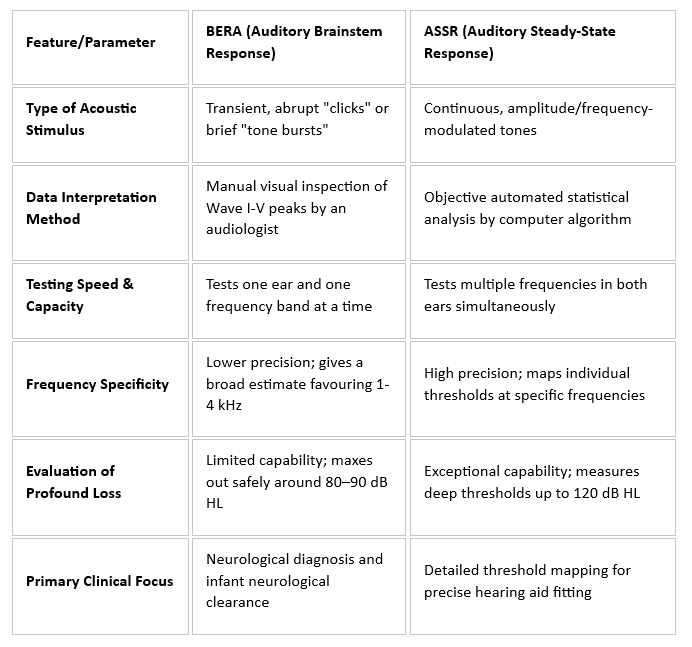
While BERA uses transient, brief acoustic clicks that sample a broad swath of the hearing spectrum at once, ASSR uses continuous, rapidly modulated tones. The human brain naturally synchronizes its electrical activity to match the modulation rate of a steady sound stream. This phenomenon is known as a phase-locked “steady-state” response.
Instead of an audiologist manually examining a chart to identify visual wave peaks, the ASSR computer system uses sophisticated mathematical algorithms (like Fast Fourier Transform) to statistically determine if the patient’s brain is responding to the specific sound frequency. If the brain’s electrical activity matches the rhythm of the stimulus, the computer logs a positive response.
The defining advantage of ASSR is its ability to test multiple frequencies simultaneously in both ears. An audiologist can test 500 Hz, 1000 Hz, 2000 Hz, and 4000 Hz across both the left and right ears all at the same time. This significantly reduces overall testing time.
Furthermore, ASSR provides superior resolution for severe-to-profound hearing losses. Because BERA relies on short, brief clicks, it cannot safely deliver the prolonged acoustic energy required to accurately measure hearing thresholds above 90 dB HL (decibels hearing level). ASSR uses continuous tones, allowing it to differentiate between a severe hearing loss and a total, profound loss. This differentiation is vital when determining if a child is a candidate for a high-powered hearing aid or a cochlear implant.
To understand the practical differences between these two methodologies, let’s look at how they compare across key clinical parameters:
A routine pure-tone test remains the right starting point for most adults. However, a specialized BERA or ASSR test is needed under several specific clinical conditions:
A failed newborn hearing screening can be alarming for parents, but it is often due to temporary fluid or vernix trapped in the baby’s tiny ear canal. A diagnostic BERA test is scheduled within the first few weeks of life to check the health of the auditory nerve pathway and ensure any permanent hearing loss is identified and managed before it impacts speech milestones.
Children with autism spectrum disorder (ASD), global developmental delays, attention deficit hyperactivity disorder (ADHD), or cognitive challenges often struggle to sit still or follow instructions during a standard booth test. BERA and ASSR allow audiologists to collect highly accurate, complete diagnostic data while the child is resting quietly or under mild sedation.
If you experience a noticeable drop in hearing in only one ear, or if you develop ringing (tinnitus) or balance issues isolated to one side, an audiologist must rule out retro cochlear pathologies. BERA is an efficient tool to verify that the electrical timing along the auditory nerve pathway is symmetrical and free from structural blockages.
If a young child is diagnosed with permanent sensorineural hearing loss, they must be fitted with hearing aids immediately. However, an audiologist cannot safely program a hearing aid based on generalized data. ASSR is used here to generate an objective, frequency-specific map that mimics a standard pure-tone audiogram, allowing the paediatric audiologist to customize amplification levels for the child’s specific ears.
A major benefit of these tests is that they are entirely painless and non-invasive. There are no needles, sharp sensations, or unpleasant procedures involved.
Skin Prep & Electrode Placement ➔ Earphone Insertion ➔ Relaxation/Sleep Period ➔ Computerized Data Collection
For adult patients, the preparation is simple: you will lie down on a comfortable reclining chair, have the skin on your forehead and earlobes gently cleaned with a mild exfoliating gel, and have small adhesive sensor pads attached. You will be asked to close your eyes, stay still, and relax or drift off to sleep to minimize muscle artifacts that can interfere with the computer readings.
For infants and toddlers, preparation requires a bit more planning. Because physical movement, crying, or even tense jaw muscles can distort the micro-volt electrical signals, young children must be completely asleep during data collection.
Parents are typically advised to keep the child awake for a few hours before the appointment and delay a feeding until arriving at the clinic. Once at the office, feeding the baby often naturally induces a deep, natural sleep, allowing the audiologist to complete the assessment smoothly. For older toddlers who cannot sleep on cue, a physician-supervised, mild paediatric sedative may be recommended.
EXCELLENTTrustindex verifies that the original source of the review is Google. Best servicePosted onTrustindex verifies that the original source of the review is Google. All type of hearing aids are availablePosted onTrustindex verifies that the original source of the review is Google. A trusted and familiar hearing aids clinicPosted onTrustindex verifies that the original source of the review is Google. Signia best h/aidPosted onTrustindex verifies that the original source of the review is Google. Signia best hearing aidPosted onTrustindex verifies that the original source of the review is Google. Signia best hearing aidPosted onTrustindex verifies that the original source of the review is Google. A range of hearing aids are availablePosted onTrustindex verifies that the original source of the review is Google. Very fast and prompt service......liked itPosted onTrustindex verifies that the original source of the review is Google. Hearing machine in good condition, staff is good and polite.Posted onTrustindex verifies that the original source of the review is Google. Best hearing aidsVerified by TrustindexTrustindex verified badge is the Universal Symbol of Trust. Only the greatest companies can get the verified badge who has a review score above 4.5, based on customer reviews over the past 12 months. Read more
Q1. Is a BERA test painful or dangerous for young children?
No, the BERA test is completely non-invasive, safe, and entirely painless. It reads the natural electrical activity already generated by the nervous system. The surface electrodes stick to the skin like small stickers, and the sounds played through the earphones are set to safe, controlled volumes.
Q2. How long does a combined BERA and ASSR evaluation take?
A standard standalone BERA test takes between 30 to 45 minutes of quiet sleep time. If an ASSR evaluation is performed simultaneously or consecutively to build a detailed frequency map, the entire procedure generally takes between 60 to 90 minutes.
Q3. Can a BERA test detect an acoustic neuroma?
Yes. BERA is highly sensitive to changes in neural timing. If a benign tumour like an acoustic neuroma is pressing against the auditory nerve, it slows down the transmission of electrical signals, causing abnormal wave latencies (specifically delaying Wave V) when compared to the healthy ear.
Q4. Why choose ASSR over BERA if a child has profound hearing loss?
ASSR is preferred for profound hearing loss because it uses continuous modulated tones that can safely deliver higher sound intensities (up to 120 dB HL) than BERA’s brief clicks. This helps audiologists determine if the child has usable residual hearing or if a cochlear implant is the better option.
Q5. Can a BERA or ASSR test be performed while the patient is awake?
Adults can remain awake if they can sit completely still and keep their facial and neck muscles fully relaxed. For infants and young children, however, the test must be performed while they are asleep, as movement and muscle tension can obscure the delicate brainwaves being measured.
Q6. What is the difference between sensorineural and retro cochlear hearing loss?
Sensorineural hearing loss generally refers to damage located inside the inner ear’s hair cells (cochlea). Retro cochlear hearing loss refers to issues located further along the auditory pathway, such as the auditory nerve or the brainstem pathways that transmit those signals to the brain.
Q7. Does a flat line on a BERA wave chart mean a child is completely deaf?
Not necessarily. A flat line indicates that no synchronous neural response was detected at the test’s maximum output limits. It points to a severe-to-profound hearing loss, but an ASSR test or further clinical evaluation is needed to check for ultra-high frequency residual hearing or potential auditory neuropathy.
Q8. How should parents prepare an infant for an unsedated BERA test?
Parents should try to keep the infant awake and active for a few hours before the appointment and bring them to the clinic hungry. Feeding the infant right before the test begins inside the quiet room is an effective way to help them fall into the deep, natural sleep required for the evaluation.
Q9. Can middle ear fluid alter the results of a BERA or ASSR test?
Yes. If fluid is trapped in the middle ear (a condition called Otitis Media with Effusion), it acts as a physical barrier that softens the sound before it reaches the inner ear. This shifts wave latencies and raises thresholds, which is why a quick pressure test (tympanometry) is usually performed first.
Q10. Are the results of BERA and ASSR tests available immediately?
Yes, the raw data wave charts and statistical confirmations are generated in real-time by the testing computer. However, a paediatric or diagnostic audiologist must carefully review, interpret, and cross-reference these findings to construct a formal, actionable diagnostic report.
📞 Because hearing care shouldn’t rely on guesswork
If standard tests aren’t giving you the full picture, it’s time to look deeper. Discover how objective brainwave tracking changes the game for complex hearing issues—and find out exactly when your path to the right hearing aid starts with an advanced diagnostic.
Book your Free Hearing Test Today, Click Here to Book Your Appointment
Speak to an Expert: Call our Toll-Free number 1800 570 9930 (Available Mon-Sat | 10:00 am – 6:30 pm)
Visit CC Saha Ltd.—90 Years of Trust and Excellence.
#HearingHealth #AudiologyAvenue #BERATest #ASSRTest #HearingLoss #PediatricAudiology #NewbornHearingScreening #AudiologyAdvanced #CCSahaLtd #HearingCare #CCSahaLtd #AudiologyAvenue
Signia’s Brilliant Sound Galaxy in Kolkata at C.C. Saha Ltd. BSG offering a revolutionary hearing experience with immersive sound domes, AR demos, and personalized care.

Personalized Experience: The myPhonak app allows you to customize your hearing experience to suit your individual needs. … Take control of your hearing experience with the myPhonak app. Adjust settings, create personalized sound profiles, and even receive remote support from your audiologist.

Hearing aids are now stylish, connected, and enhance your overall lifestyle. Imagine effortlessly streaming your favorite music, taking important calls, or even tracking your fitness goals, all through your hearing aids.

Noise pollution levels in Kolkata have reached alarming heights, with constant traffic, honking, and construction noise taking a toll on residents’ health. From temporary hearing loss to permanent damage and elevated stress, the city’s rising noise levels are a silent epidemic.
Your ears, your health, your choice. Act now!
Be a Noise Vigilante
Struggling with hearing loss in one ear? CC Saha Hearing Clinics in Kolkata provide expert solutions, backed by over 90 years of excellence in hearing care.

Cochlear Implants in Kolkata are changing young lives, but proper aftercare is essential. Learn about post-implant home care, speech therapy benefits, and how parents can help their children thrive with sound.