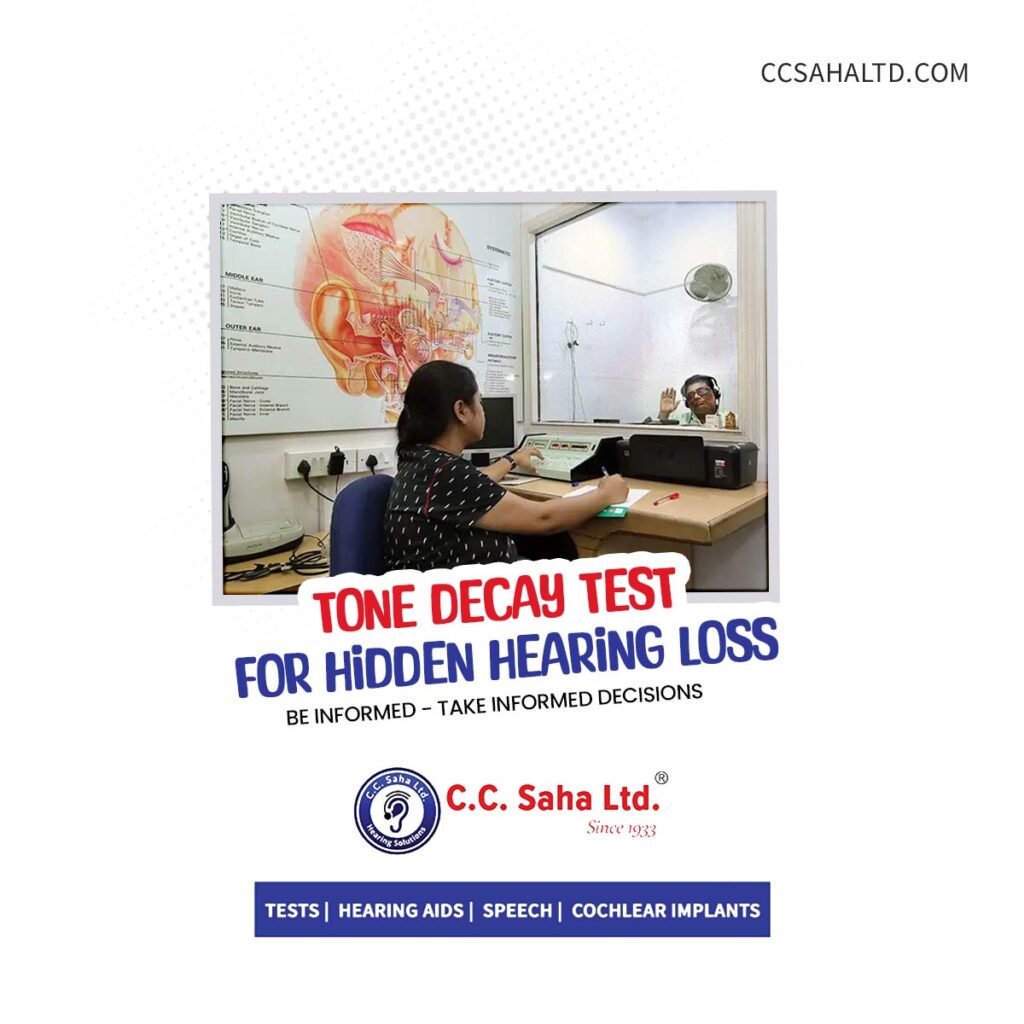
Tone Decay Test
for Hidden Hearing Loss

Be Informed - take informed decision

Does it often happen with you at a noisy Kolkata café, when speaking with friends, and suddenly someone points out that you’re missing bits of conversation. You laugh it off, blaming the background buzz, but deep down, you wonder—is my hearing okay?

This is where audiology magic comes in, and more specifically, the tone decay test for hidden hearing loss. Unlike a standard hearing test, this one digs deeper. It screens for those tricky conditions where sound just fades away from your ears faster than it should—as if your hearing stamina runs out. Scary? A little. Preventable? Yes.

At CC Saha Ltd, with over 80 years of expertise audiology, patients no longer have to guess whether their hearing issues are “just in their head.” Tests like the tone decay assessment separate fact from fear.

Let’s decode what this test is, why it matters to Kolkata professionals aged 25-35 (hello work stress, late-night reels, and AirPods life), and how CC Saha can help protect your future hearing today.

Table of Contents
Tone-Decay-Test-for-Hidden-Hearing-Loss-Audiology-Avenue---CC-Saha-Ltd

The tone decay test for hidden hearing loss is an audiology tool designed to measure how well the ear sustains perception of sound over time. Unlike a regular hearing test that checks whether you hear a sound, this test checks if you can continue hearing it consistently.

Here’s the concept:

  • A continuous tone (usually at a frequency where you’re struggling) is played into your ear.
  • If you hear it and keep hearing it for 60 seconds, no problem—your auditory system has stamina.
  • If within a short while it fades or disappears, that’s tone decay.

This decay pattern suggests issues with your auditory nerve or cochlea. It can indicate early nerve fatigue, cochlear pathology, or retrocochlear disorders (conditions behind the cochlea, such as acoustic neuroma).

Simply put, the tone decay test is the doctor’s way of asking: “Your ears can start the race, but can they run the full lap?”

Your Instagram feed doesn’t show it, but hidden hearing loss is real. Unlike obvious deafness, this loss lurks in the background:

  • Regular audiograms may come out normal.
  • You hear tones in quiet settings but struggle in noisy environments.
  • Conversations sound muffled even when the volume is okay.

Why? Because the damage is often in the synapses connecting hair cells to the auditory nerve, not just the cells themselves. Think of it as ear “wiring issues.”

The danger? People delay seeking help until it’s too late. A tone decay test narrows down this detection window before permanent damage happens.

Your Instagram feed doesn’t show it, but hidden hearing loss is real. Unlike obvious deafness, this loss lurks in the background:

  • Regular audiograms may come out normal.
  • You hear tones in quiet settings but struggle in noisy environments.
  • Conversations sound muffled even when the volume is okay.

Why? Because the damage is often in the synapses connecting hair cells to the auditory nerve, not just the cells themselves. Think of it as ear “wiring issues.”

The danger? People delay seeking help until it’s too late. A tone decay test narrows down this detection window before permanent damage happens.

Understanding it in layman-speak:

  • Your auditory system is designed to hold signals constant.
  • If the nerve or cochlea has weakness, the signal fades out before one minute.
  • That fading is recorded as “decibels needed” to keep the tone audible.

Audiologists classify:

  • Normal: <5 dB decay
  • Mild abnormal: 10–15 dB
  • Severe: >30 dB decay

This isn’t just exam math. These results help audiologists differentiate between cochlear pathology (inner ear) and retrocochlear pathology (nerve-related).

Call Us for Support

[Mon – Sat, 10am – 6pm]

At CC Saha Ltd, here’s how you’d experience it:

  1. You’re seated in a sound-treated room.
  2. Headphones deliver pure tones at your hearing threshold level.
  3. If you can’t sustain hearing the tone for 60 seconds, intensity is raised in small steps.
  4. The audiologist notes how much louder the tone has to be before it stays audible.

This feels super comfortable. No needles, no pain—just sitting and listening.

If you:

  • Constantly raise TV volume saying “others mumble.”
  • Find it impossible to follow speech in crowds.
  • Experience ringing in the ears (tinnitus).
  • Work in high-noise spaces (factories, DJs, call centers).
  • Have sudden unexplained dips in hearing clarity.

Then yes—you should get the tone decay test for hidden hearing loss done.

Between metro rides, Durga Puja pandals, dhaak beats, and headphone marathons, your ears really go through a lot. Data shows metro professionals and young adults face increasing hidden hearing loss due to:

  • Prolonged earphone use at unsafe volume.
  • Urban noise pollution.
  • Ignoring early hearing fatigue.

The tone decay test is a quick investment to confirm that your lifestyle isn’t stealthily damaging your hearing.

Legacy of Trust: 80 years serving Bengal in audiology and ENT.

Advanced Tech: State-of-art diagnostic audiometers used for tone decay analysis.

Expert Team: RCI Certified Audiologists experts in hidden hearing loss detection.

Holistic Care: From diagnosis to world-class hearing aid solutions.

Call Us for Support

[Mon – Sat, 10am – 6pm]

Frequently Asked Questions (FAQs)

Q1. What exactly is a tone decay test?
It’s a hearing test that measures whether a person can sustain perception of a tone for 60 seconds at their hearing threshold.

Q2. Is the test painful?
No. It’s completely painless and only requires listening to tones.

Q3. Who usually needs this test?
People with suspected hidden hearing loss or difficulty hearing speech in noisy places.

Q4. How long does it take?
Usually between 10–15 minutes.

Q5. Can hidden hearing loss be missed in regular tests?
Yes, and that’s why tone decay testing is vital for accurate diagnosis.

Q6. What equipment is used?
Diagnostic audiometer equipment with tone decay features.

Q7. What do abnormal results mean?
They may suggest cochlear or retrocochlear pathology requiring further tests.

Q8. Is tone decay related to tinnitus?
Yes, both can signal inner ear or nerve fatigue.

Q9. Do young people need this test?
Yes, especially if they use headphones daily or face chronic ear fatigue.

Q10. How does CC Saha Hearing Clinics conduct the test?
In a quiet sound room with calibrated audiometers.

Q11. Can tone decay detect tumors?
It can suggest retrocochlear issues like acoustic neuroma, which require further scans.

Q12. Will insurance cover this test?
Coverage depends on policy.

Q13. How often should one test hearing?
Once a year if you’re exposed to high noise levels regularly.

Q14. Does tone decay mean permanent loss?
Not always. Early detection allows management and intervention.

Q15. Where can I get this test done in Kolkata?
At any one of the 5 centres of CC Saha Ltd. Across Kolkata → Esplanade, Prince Anwar Shah Road, Dunlop, Salt Lake, and Barasat

Ready for Sound Clarity? Secure Your Hearing Test with CC Saha Ltd.

Hidden hearing loss doesn’t announce itself—it creeps in quietly. Don’t wait until you start saying “What?” too often. Book your tone decay test for hidden hearing loss at CC Saha Ltd today and give your ears the care they deserve. 

Call toll free [Mon-Sat | 10am-6pm] 1800 570 9933 or visit your nearest CC Saha Ltd. hearing clinic to reclaim clarity in your day!

Read More...
Hearing-Loss-Solutions-for-Commuters-in-Kolkatae
Hearing Loss Solutions for Commuters in Kolkata

At CC Saha Hearing Clinics, we’ve worked with countless families and understand the concerns that come with such an important decision. With our 90+ years of expertise, top audiologists, and partnerships with world-class brands like Med-EL and Cochlear, we’re here to guide you for your child’s cochlear implants every step of the way.

Read More »
Prevent-Hearing-Aid-Damage
How to Prevent Hearing Aid Damage

At CC Saha Hearing Clinics, we’ve worked with countless families and understand the concerns that come with such an important decision. With our 90+ years of expertise, top audiologists, and partnerships with world-class brands like Med-EL and Cochlear, we’re here to guide you for your child’s cochlear implants every step of the way.

Read More »
Preparing-for-Cochlear-Implant-Surgery---What-Parents-in-Kolkata-Should-Expect
Cochlear Implant Surgery – What Kolkata Parents Need to Know

At CC Saha Hearing Clinics, we’ve worked with countless families and understand the concerns that come with such an important decision. With our 90+ years of expertise, top audiologists, and partnerships with world-class brands like Med-EL and Cochlear, we’re here to guide you for your child’s cochlear implants every step of the way.

Read More »
Where can I get a free hearing aid trial in Kolkata
Where can I get a free hearing aid trial in Kolkata?

At CC Saha, we believe you shouldn’t have to make such a vital decision without first-hand experience. That’s why our free trials offer you the chance to evaluate how advanced hearing aids perform in your everyday environments—be it at home, during work meetings, or out in Kolkata’s dynamic streets. It’s a commitment-free way to explore the benefits, understand the technology, and take control of your hearing journey with confidence.

Read More »
How-Speech-Therapy-helps-Children-with-Cochlear-Implants-Improve-Communication---28-Oct-24--CC-Saha-Ltd
How Speech Therapy Helps Children with Cochlear Implants Improve Communication

Think of it as a bridge between hearing sounds and using them to communicate. In these sessions, trained therapists work with your child to connect the sounds they’re hearing with the words they need to express themselves. It’s like teaching a new language, with therapists gently guiding children to associate sounds with meaning, words, and eventually sentences. Speech therapy transforms hearing into understanding and understanding into speech.

Read More »