

Brilliant Sound Galaxy
Signia’s Brilliant Sound Galaxy in Kolkata at C.C. Saha Ltd. BSG offering a revolutionary hearing experience with immersive sound domes, AR demos, and personalized care.
Travelling is one of life’s most enriching experiences, opening doors to new cultures, breathtaking landscapes, and unforgettable sensory environments. However, for individuals living with hearing impairment, the prospect of navigating bustling transport hubs, unfamiliar acoustic settings, and fluctuating climates can trigger a degree of travel anxiety.
At CC Saha Ltd., we believe that hearing loss should never restrict your wanderlust. Modern hearing technology is engineered to keep you connected to the world around you, no matter where your itinerary takes you. Achieving a seamless, stress-free journey simply comes down to strategic preparation and expert insight.
In this exhaustive guide, we have compiled a set of audiologist recommended tips for travelling with your Hearing Aid. From pre-flight packing checklists to managing environmental changes at your destination, this blueprint ensures you never miss a moment of your adventure.
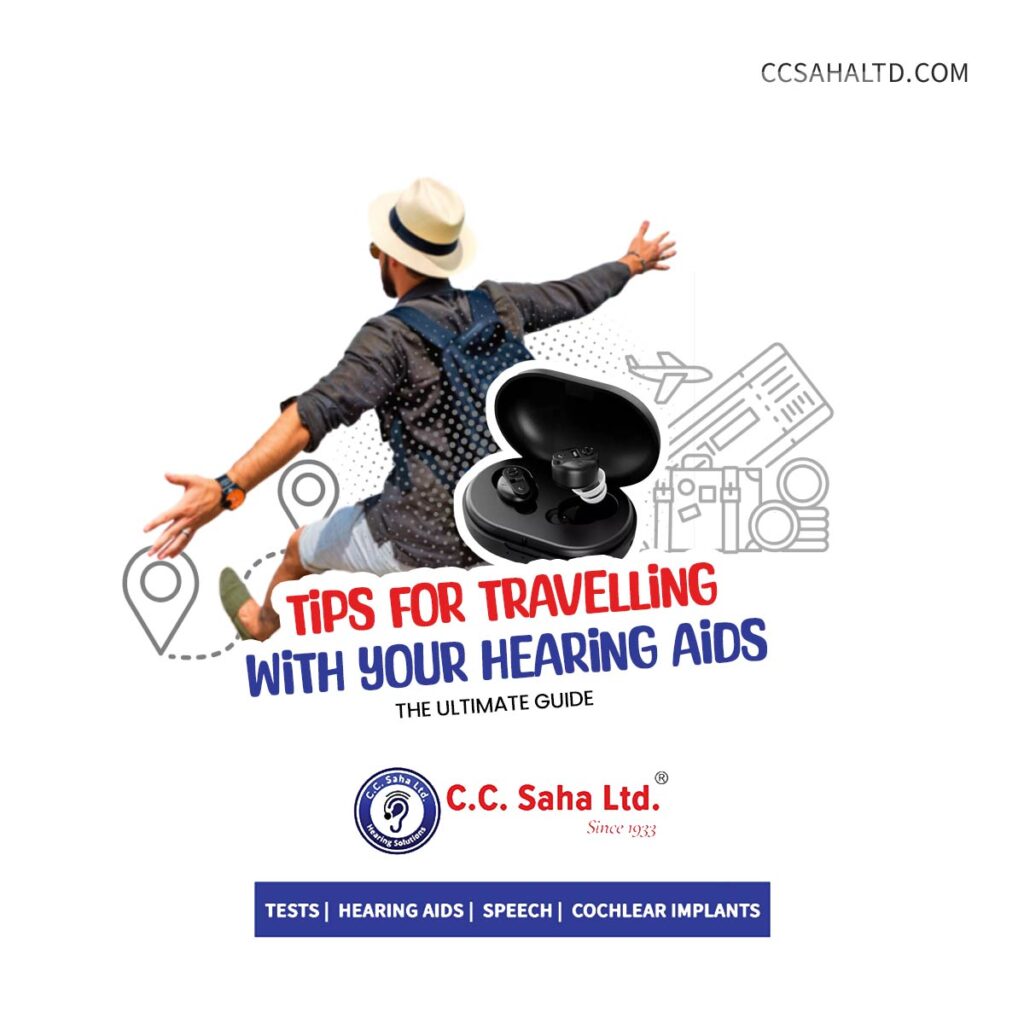
The secret to a successful journey begins long before you arrive at the boarding gate. Proper preparation ensures that minor equipment issues don’t transform into holiday-disrupting emergencies.
Two to three weeks before your departure, schedule a brief maintenance visit at your trusted hearing care clinic. There you can have a professional deep clean, get checked for internal moisture, verify firmware updates, and ensure that your wax guards and tubes are immaculate. If you are travelling internationally to a country that utilizes advanced assistive listening infrastructure, your audiologist can also program a dedicated “Telecoil” or “Speech in Noise” setting into your devices.
Never scatter your hearing accessories across various compartments of your checked luggage. Dedicate a brightly coloured, shockproof, and water-resistant pouch specifically for your auditory essentials. This kit should remain inside your personal carry-on bag at all times.
Your kit must include:
Power Solutions: If you use zinc-air batteries, calculate the number of days you will be away and pack double the quantity you typically consume. Travel routines often require wearing devices for longer hours, accelerating power depletion. If you use rechargeable devices, pack the primary charging dock, the necessary USB cables, and a high-capacity portable power bank to safeguard against delayed flights or missing wall outlets.
International Voltage Adapters: Electrical configurations vary globally. Ensure your adapter accommodates the voltage and plug shape of your destination country so you do not damage your charging dock.
Dehumidifier or Drying Beaker: Environmental shifts can introduce internal moisture to your devices. A electronic drying cup or a sealed jar with desiccant crystals is mandatory for maintaining electronic integrity.
Maintenance Tools: Include your wax cleaning brush, wire loops, multi-tool, and an abundant supply of spare wax guards, domes, or retention locks.
Navigating transit hubs requires heightened awareness. Airports and train stations are acoustic nightmares characterized by soaring ceilings, reflective hard surfaces, reverberations, and overwhelming ambient noise.
One of the most frequent points of anxiety for travellers is the security screening process. The official protocol from global transportation security administrations is clear: you are not required to remove your hearing aids when passing through airport security. * Communicate Immediately: Before stepping through the metal detector or advanced imaging technology (body scanner), politely inform the security officer that you are wearing prescription hearing instruments.
The Science of Scanners: Modern walk-through metal detectors and full-body scanners use low-intensity electromagnetic fields that will not damage digital hearing aids or alter their internal programming. Furthermore, they rarely trigger security alerts. However, if a secondary manual screening is requested, simply remind the officer of your devices.
X-Ray Luggage Scanners: While your ears are safe, never place spare hearing aids, external battery chargers, or streaming accessories directly through the carry-on X-ray conveyor belt without telling the operator, though standard X-ray fields will not corrupt digital components.
Once on board, the steady drone of jet engines can reach up to 85 decibels, masked beneath a layer of cabin pressure variations.
Keep Your Devices Switched On: It is a common misconception that you should remove your hearing aids during a flight to block out engine roar. Doing so isolates you from crucial safety briefings, captain announcements, and interaction with flight attendants. Modern hearing aids feature sophisticated digital noise reduction algorithms that recognize continuous, ambient engine hum and automatically attenuate it while elevating human speech.
The “Electronic Device” Policy: When airline staff mandate that all cellular phones and tablets be switched to “Airplane Mode,” this directive does not apply to medical hearing instruments. Even if your devices utilize Bluetooth connectivity to pair with your phone, the low-energy Bluetooth frequency is completely safe for aircraft navigation systems. You can continue streaming downloaded audio or podcasts seamlessly.
Leverage Digital Airline Applications: Prior to departure, download the official mobile app of your airline and enable push notifications. Because gate announcements over public address systems can be distorted by poor acoustics, receiving real-time, text-based updates regarding gate changes, delays, and boarding times directly to your smartphone ensures you stay perfectly informed.
Your destination may present environmental conditions vastly different from the microclimate your hearing aids are accustomed to. Safeguarding your devices against external threats preserves their performance lifecycle.
If your travels take you to humid coastal regions or tropical destinations, moisture becomes enemy number one. Atmospheric condensation can seep into the microphone ports and battery compartments, corroding delicate wiring and causing intermittent short-circuiting.
The Overnight Drying Routine: Make it an unbroken rule to place your hearing aids inside a dedicated dehumidifier every night while you sleep. If you use zinc-air batteries, open the battery door completely and remove the cell before placing the device into the drying chamber.
Perspiration Management: Active excursions like hiking or exploring humid city centres induce sweat. Utilize absorbent hearing aid sweat bands or protective acoustic sleeves that slide over the body of behind-the-ear (BTE) models to catch moisture before it enters the seams.
A day at the beach or an excursion through arid desert terrain introduces microscopic particulate matter that can clog acoustic ports and damage receivers.
The Safe Storage Rule: Never leave your hearing aids exposed on a beach towel, table, or inside a soft pocket where sand can penetrate. When you remove your devices to swim or participate in water sports, seal them immediately inside an airtight, shockproof, waterproof dry box.
Clean Hands Only: Avoid adjusting your volume buttons or changing wax guards while your fingers are covered in sunblock, salt water, or sand. Wash and dry your hands thoroughly before handling your devices.
Maximizing your enjoyment at your destination requires strategic interaction with your new surroundings.
When checking into your hotel, don’t hesitate to disclose your hearing requirements to the front desk staff.
Visual Alert Systems: Many modern international hotel chains provide accessible rooms equipped with visual notification devices. These include strobe lights linked to the room’s smoke detector, door knock sensors, and vibrating alarm clocks that fit beneath your pillow.
The Nightstand Protocol: Hotels feature unfamiliar layouts. To avoid accidentally knocking your expensive devices off a nightstand in the dark, place a bright, easily identifiable tray or container on your bedside table. Keep your hearing aids enclosed within this boundary every night so they are never misplaced or exposed to spilled water glasses.
Museums, historic monuments, and theatre venues can be acoustically challenging due to high crowds and echo.
Inquire About Loop Systems: Look for the international accessibility symbol showing an ear icon with a diagonal line. This indicates the presence of an induction loop system. Switch your hearing aid to the “T” (Telecoil) position to stream the tour guide’s microphone audio directly into your ears, entirely bypassing background chaos.
Utilize Companion Microphones: If you possess a proprietary remote companion microphone (such as a Roger Pen, Starkey Remote Mic, or Signia Streamline Mic), request your tour guide to clip it to their lapel. This provides an intimate, clear audio stream from up to twenty meters away.
EXCELLENTTrustindex verifies that the original source of the review is Google. Best servicePosted onTrustindex verifies that the original source of the review is Google. All type of hearing aids are availablePosted onTrustindex verifies that the original source of the review is Google. A trusted and familiar hearing aids clinicPosted onTrustindex verifies that the original source of the review is Google. Signia best h/aidPosted onTrustindex verifies that the original source of the review is Google. Signia best hearing aidPosted onTrustindex verifies that the original source of the review is Google. Signia best hearing aidPosted onTrustindex verifies that the original source of the review is Google. A range of hearing aids are availablePosted onTrustindex verifies that the original source of the review is Google. Very fast and prompt service......liked itPosted onTrustindex verifies that the original source of the review is Google. Hearing machine in good condition, staff is good and polite.Posted onTrustindex verifies that the original source of the review is Google. Best hearing aidsVerified by TrustindexTrustindex verified badge is the Universal Symbol of Trust. Only the greatest companies can get the verified badge who has a review score above 4.5, based on customer reviews over the past 12 months. Read more
Q1. Can I wear my hearing aids while swimming or taking a bath during my vacation?
No, you should never wear standard hearing aids while swimming, bathing, or entering a sauna. While many premium modern hearing instruments possess an IP68 water-resistant rating—meaning they can withstand accidental splashes or heavy rain—they are not completely waterproof. Submerging them in water, particularly chlorinated pool water or saline ocean water, can ruin internal microphones, corrupt micro-circuitry, and void your manufacturer warranty. Always store them securely in a waterproof container before entering the water.
Q2. Will passing through airport body scanners or metal detectors erase my hearing aid settings?
No, the electromagnetic fields generated by standard airport security walkthrough metal detectors and advanced full-body scanners are completely safe for digital hearing instruments. They will not erase your audiologist’s programming, corrupt internal memory chips, or alter your custom acoustic settings. You can safely wear your devices through the checkpoint without fear of structural or technological damage.
Q3. What should I do if my hearing aid accidentally gets wet while travelling?
If your device is exposed to significant moisture, act immediately. Turn off the power and remove the battery if it uses disposable cells. Wipe the exterior surface thoroughly with a dry, lint-free microfiber cloth. Place the open device into your electronic hearing aid dehumidifier or a sealed container filled with silica gel desiccant crystals for at least 12 to 24 hours. Never use an external heat source like a hair dryer, microwave, or direct sunlight to dry the device, as intense heat will warp the plastic casing and melt delicate interior connections.
Q4. Are rechargeable hearing aid cases allowed inside checked luggage on commercial flights?
No, you must never place rechargeable hearing aid cases or spare lithium-ion power banks within your checked luggage. Commercial airline safety regulations mandated by the International Civil Aviation Organization state that all loose lithium-ion batteries must be carried exclusively inside your hand luggage or carry-on personal items. This allows the flight crew to monitor and respond effectively in the extremely rare event of battery thermal runaway.
Q5. How do I prevent losing my hearing aids while engaging in active outdoor excursions?
To secure your devices during high-movement activities like zip-lining, sailing, or hiking, utilize specialized retention accessories. Hearing aid clips feature flexible silicone loops that wrap tightly around the body of your BTE devices, connected by a durable cord that clips firmly onto the collar of your shirt. Additionally, be exceptionally cautious when removing hats, sunglasses, or face masks, as the straps can easily snag your hearing aid and inadvertently pull it off your ear.
Q6. Should I adjust my hearing aid volume when navigating an exceptionally loud train station or airport?
Rather than manually turning down the volume—which reduces your ability to perceive vital ambient safety announcements—you should switch your device to its specialized environmental programs. Use your smartphone app or the onboard toggle button to select a “Speech in Noise,” “Restaurant,” or “Outdoor” program. These specialized algorithms specifically isolate and suppress low-frequency background rumbles while optimizing directional microphones to focus on immediate human speech.
Q7. Can I connect my Bluetooth-enabled hearing aids to an airplane’s in-flight entertainment system?
Yes, you can connect your devices, but it generally requires a specialized external accessory. Most aircraft seatback entertainment screens utilize a traditional 3.5mm analogue audio jack rather than native Bluetooth pairing protocols. By packing a portable Bluetooth transmitter (such as an Air Fly or your manufacturer’s proprietary streaming device), you can plug the transmitter into the headphone jack and wirelessly stream high-fidelity movie audio directly into your hearing aids.
Q8. What steps should I take if my hearing aid breaks down while I am abroad?
If a structural failure occurs far from home, consult your smartphone application’s clinic locator or check the official website of your device manufacturer to find an authorized local service centre. Premium global brands offer international warranty networks, allowing certified audiologists worldwide to service your devices. Additionally, tele-audiology advancements enable remote care sessions; you can contact your home clinic at CC Saha Ltd. to perform virtual fine-tuning via your smartphone app over an internet connection.
Q9. How does extreme heat affect my spare hearing aid batteries?
Intense environmental heat accelerates the self-discharge rate of zinc-air batteries and degrades the chemical lifespan of lithium-ion systems. Never leave your hearing aid kit inside a hot car glove compartment, on a sunny windowsill, or exposed to direct sunlight on a beach table. Store all spare batteries and charging units in a cool, shaded, and well-ventilated space inside your hotel room or travel pack to preserve maximum energy density.
Q10. Is it necessary to inform my tour guide or cruise liner about my hearing impairment?
Yes, proactively disclosing your hearing loss to service providers is highly recommended and ensures a safer, more comprehensive experience. Informing tour guides allows them to position themselves face-to-face when delivering commentary, facilitating easier lip-reading. Informing a cruise line guarantees that your cabin can be outfitted with vital visual alert infrastructure for emergency alarms and ensures that crew members are aware of your communication profile during safety drills.
📞 Regular Hearing Checkup equally important as your Health Checkups.
Delay can increase your problems. Early intervention powered by precision diagnostics changes lives.
Book your childs first check: Click Here to Book Your Appointment
Speak to an Expert: Call our Toll-Free number 1800 570 9930 (Available Mon-Sat | 10:00 am – 6:30 pm)
Visit CC Saha Ltd.—90 Years of Trust and Excellence.
#HearingAidTips #TravelWithHearingAids #AudiologyAvenue #CCSahaLtd #HearingCare #Wanderlust #HearingLossAwareness #SafeTravels #RechargeableHearingAids #KolkataAudiology
Signia’s Brilliant Sound Galaxy in Kolkata at C.C. Saha Ltd. BSG offering a revolutionary hearing experience with immersive sound domes, AR demos, and personalized care.

Personalized Experience: The myPhonak app allows you to customize your hearing experience to suit your individual needs. … Take control of your hearing experience with the myPhonak app. Adjust settings, create personalized sound profiles, and even receive remote support from your audiologist.

Hearing aids are now stylish, connected, and enhance your overall lifestyle. Imagine effortlessly streaming your favorite music, taking important calls, or even tracking your fitness goals, all through your hearing aids.

Noise pollution levels in Kolkata have reached alarming heights, with constant traffic, honking, and construction noise taking a toll on residents’ health. From temporary hearing loss to permanent damage and elevated stress, the city’s rising noise levels are a silent epidemic.
Your ears, your health, your choice. Act now!
Be a Noise Vigilante
Struggling with hearing loss in one ear? CC Saha Hearing Clinics in Kolkata provide expert solutions, backed by over 90 years of excellence in hearing care.

Cochlear Implants in Kolkata are changing young lives, but proper aftercare is essential. Learn about post-implant home care, speech therapy benefits, and how parents can help their children thrive with sound.