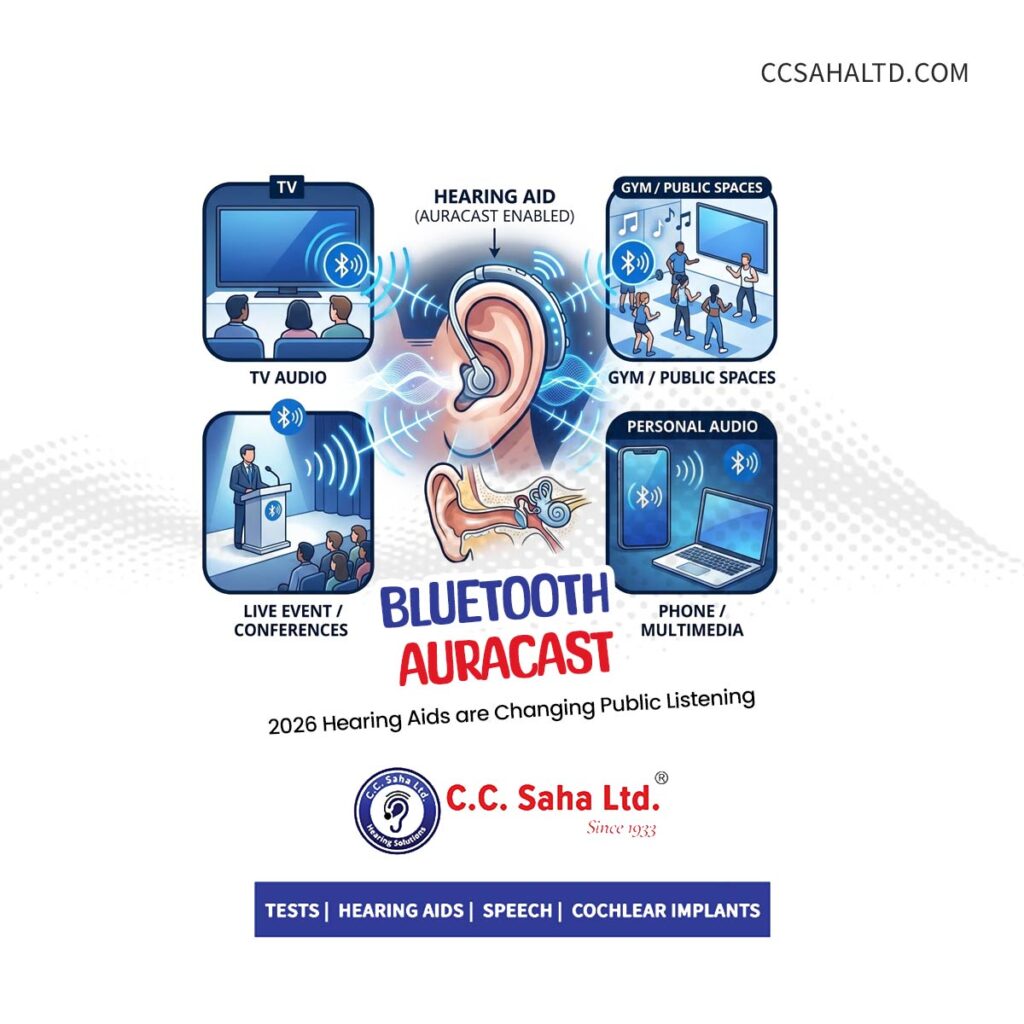
Bluetooth
Auracast

2026 Hearing Aids Are Changing Public Listening

The landscape of auditory accessibility is shifting under our feet. For decades, individuals navigating hearing loss in public environments—such as crowded transit hubs, echoing lecture halls, and bustling sports bars—relied on technologies that, while revolutionary for their time, came with distinct limitations. In 2026, a transformative standard has taken center stage.

Bluetooth Auracast, an advanced capability born from the Bluetooth Low Energy (LE) Audio architecture, is rewriting the rules of engagement between assistive devices and shared spaces. By allowing a single audio transmitter to broadcast synchronized sound streams to an unlimited number of nearby receivers, this technology is turning public listening into a truly seamless, highly personalized experience.

For CC Saha Ltd.’s Audiology Avenue, we explore how this technology functions, its structural advantages over legacy systems, its real-world implementation in 2026, and why it represents the future of universal design.

Table of Contents
Bluetooth-Auracast-2026-hearing-Aids-are-changing-public-listening---Kolkata--Audiology-Avenue---CC-Saha-Ltd

To understand why Bluetooth Auracast is a massive leap forward, we must look at what preceded it. For more than half a century, the primary method for delivering public audio directly to hearing aids was the induction loop system, or telecoil (T-coil).

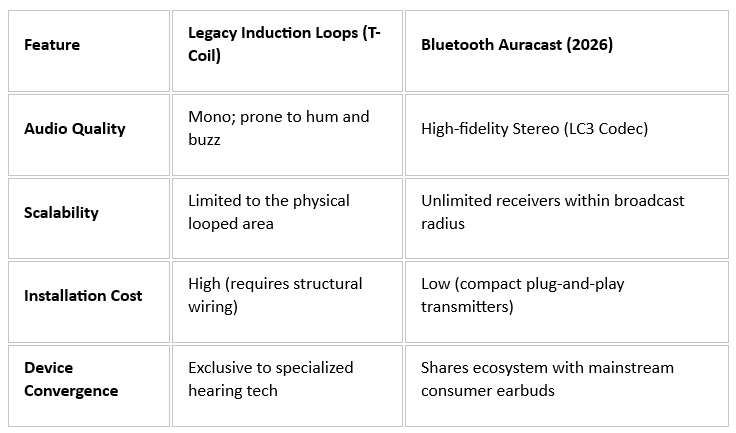
While T-coils have been a reliable mainstay, they require dedicated, expensive physical wiring infrastructure installed beneath floors or inside walls. Furthermore, they are susceptible to electromagnetic interference from surrounding electronics and only broadcast in monaural (mono) sound.

Traditional point-to-point Bluetooth, while excellent for pairing a single smartphone to a pair of hearing aids, fundamentally cannot scale to public spaces. It operates on a strict one-to-one architecture. If you connect your hearing aids to a digital screen at an airport gate, no one else can hook into that same stream.

Bluetooth Auracast shatters this barrier by decoupling the transmitter from a single target device. It functions much like a localized radio tower, broadcasting high-quality, stereo digital audio streams that any compatible hearing aid, cochlear implant, or consumer earbud can tune into simultaneously without performance degradation.

At the core of this transformation is Bluetooth LE Audio, operating on the energy-efficient LC3 (Low Complexity Communication Codec) framework. This protocol optimizes battery consumption—a primary concern for modern, ultra-compact hearing aid profiles—while drastically upgrading audio fidelity and reducing latency to imperceptible levels.

Auracast leverages this foundation to manage three distinct broadcast topologies:

  1. Unencrypted Public Broadcasts: Open channels found in transit centres, theatres, and museums where any user within range can scan and immediately receive the audio stream.
  2. Encrypted/Gated Broadcasts: Secured networks used in corporate conference rooms, fitness centres, or paid venues where a passcode, QR code scan, or NFC tap is required to access the audio.
  3. Personal Multi-Stream Share: A user-centric topology where an individual can share their personal smartphone or tablet audio directly with friends or family members wearing compatible hearing devices.

Because it operates digitally within the 2.4 GHz spectrum, it bypasses the physical and environmental constraints of legacy systems, delivering crystal-clear sound directly into the user’s ears without picking up ambient room reverberations.

In 2026, major hearing aid manufacturers have fully integrated Auracast receivers directly into their flagship architectures. This widespread adoption has unlocked practical, life-changing applications across various environments.

Transit Hubs and Silent Airports

Navigating an airport or train station with hearing loss can be highly stressful. Gate changes, delay announcements, and emergency alerts are frequently lost in the cavernous acoustic reflections of large terminals.

With an Auracast-enabled environment, a passenger’s hearing aids can continuously stream quiet background music or podcast audio from their personal device, yet dynamically cut in or overlay critical terminal announcements broadcast directly from the gate’s transmitter. The user hears the exact flight update with perfect clarity, eliminating the anxiety of missed cues.

Multi-Screen Venues and Sports Bars

In public spaces featuring multiple television monitors, such as sports bars, airport lounges, or fitness centres, muted screens have long been the norm. Auracast transforms this setup by assigning a unique audio stream to each screen.

Using an interface on their smartphone or directly through a button gesture on their hearing aid, a user can pull up a list of available local audio streams and instantly listen to the specific television screen they are watching.

Lecture Halls, Houses of Worship, and Theatres

In educational and cultural settings, distance from the speaker degrades speech intelligibility. Auracast functions as a universal remote microphone system. The presenter’s microphone feeds straight into an Auracast transmitter, broadcasting the lecture directly to every student wearing a compatible device in the room. This system removes the stigma of requesting specialized, bulky FM receiver packs from an AV desk; accessibility is completely integrated into the student’s personal hardware.

Call Us for Support

[Mon – Sat, 10am – 6:30pm]

The rapid rise of Bluetooth Auracast boils down to three strategic pillars: scalability, cost-efficiency, and consumer-device convergence.

The Strategic Shift: Why Auracast is Advancing Accessibility

By bridging the gap between specialized medical devices (hearing aids, cochlear processors) and mass-market consumer electronics (wireless earbuds, smartphones), Auracast removes the long-standing social friction associated with assistive listening technology. When a grandfather wearing prescription hearing aids and his granddaughter wearing off-the-shelf consumer earbuds can tune into the exact same museum tour audio stream using identical protocols, true universal design is achieved.

For venues, audiologists, and manufacturers looking to lead this wave, certain integration protocols must be observed:

  • Clear Digital and Physical Signage: Venues deploying Auracast should implement clear visual signage alongside digital triggers like localized location beacons or scannable QR codes at entry points to help users quickly discover active streams. 

  • Backward Compatibility Management: While 2026 models natively prioritize LE Audio, audiologists must ensure that patient configurations retain robust fallbacks—such as standard Bluetooth or T-coils—for locations still transitioning their legacy infrastructure.

  • Acoustic Balancing: Hearing care professionals need to fine-tune the environmental pass-through settings within hearing aid management apps. This ensures that when a user joins a public Auracast stream, they retain enough situational awareness of their ambient surroundings to remain safe and communicative.

Bluetooth Auracast is far more than a simple wireless upgrade; it represents the democratization of public sound. By stripping away the architectural, financial, and social barriers that limited older assistive listening setups, it delivers uncompromised sound directly to the individual. As 2026 hearing aids continue to push the boundaries of onboard intelligence and power management, the integration of Auracast ensures that public spaces will become welcoming, accessible, and perfectly audible for everyone.

Call Us for Support

[Mon – Sat, 10am – 6:30pm]

FAQs

Q1. What is Bluetooth Auracast and how does it work?

Bluetooth Auracast is a new wireless technology built on Bluetooth Low Energy (LE) Audio. It allows an audio transmitter—such as a television, microphone, or public address system—to broadcast high-quality sound to an unlimited number of nearby Bluetooth receivers simultaneously. It functions similarly to a miniature radio station, where any compatible hearing aid or earbud within range can scan, select, and tune into a specific audio stream.

Q2. How do 2026 hearing aids differ from older models regarding Auracast?

By 2026, hearing aid manufacturers have embedded native Bluetooth LE Audio hardware and the LC3 codec into their core chipsets. Older hearing aid models relied on classic Bluetooth, which only allowed one-to-one pairings and suffered from high battery drain. 2026 models can maintain connection to a personal smartphone while simultaneously scanning and streaming from public Auracast networks without killing the battery.

Q3. Can Bluetooth Auracast completely replace old T-Coil (induction loop) systems?

While Auracast is technically superior in audio quality, stereo transmission, and ease of installation, it will co-exist with T-Coil systems for some time. T-coils are deeply embedded in the infrastructure of thousands of global venues. However, Auracast is rapidly becoming the standard for new installations due to its low infrastructure cost and its ability to stream directly to both consumer earbuds and hearing aids.

Q4. Do I need a special smartphone app to connect my hearing aids to an Auracast broadcast?

In most cases, yes, though the functionality is being integrated natively into smartphone operating systems. You can use your hearing aid’s companion app or your phone’s system Bluetooth settings to scan the local area for available streams, much like searching for a Wi-Fi network. Some venues also offer QR codes or NFC touchpoints that instantly connect your device to the correct channel.

Q5. Is there a limit to how many people can connect to a single Auracast transmitter?

No, there is absolutely no limit to the number of users who can tune in. Because the transmitter simply broadcasts the signal outward without needing to acknowledge, handshake, or manage an individual two-way digital connection with each receiving device, one transmitter can serve five people or five thousand people simultaneously within its operational radius.

Q6. Will using Auracast drain my hearing aid battery faster?

No. Auracast runs on the Bluetooth Low Energy (LE) Audio standard, which utilizes the highly efficient LC3 codec. This setup actually consumes significantly less power than traditional classic Bluetooth streaming. Users can stream audio from public venues for extended periods without worrying about premature battery drain.

Q7. Can Auracast broadcasts be made private or secure?

Yes, Auracast supports encrypted configurations. While public announcements in airports or train stations are kept wide open for everyone, venues like corporate boardrooms, private classrooms, or confidential medical offices can secure their streams with a cryptographic key. Users must input a passcode, scan a secure QR code, or be physically authenticated to join the stream.

Q8. What happens to my personal phone calls if I am tuned into a public Auracast stream?

Your 2026 hearing aids are designed to intelligently prioritize your audio streams. If you are tuned into a public museum tour or airport screen via Auracast and an urgent personal phone call comes through on your paired smartphone, your hearing aids will seamlessly pause or lower the Auracast stream and route the phone call directly to you, reverting to the broadcast once the call ends.

Q9. Are consumer wireless earbuds compatible with the same Auracast systems used by hearing aids?

Yes, and this is one of the biggest benefits of the technology. Because Auracast is a universal Bluetooth standard rather than a proprietary medical protocol, mainstream consumer wireless earbuds and consumer headphones utilize the exact same technology. This unifies assistive listening and consumer audio into a single shared ecosystem.

Q10. How can I find out if a public venue supports Bluetooth Auracast?

Venues equipped with this technology typically display the official Bluetooth Auracast trademark symbol on doors, counter desks, or digital message boards. Additionally, when you open the Bluetooth broadcast scanning tool on your smartphone or hearing aid app within the venue, the available audio channels will automatically populate on your screen.

📞 2026 is all about cutting out the background noise.

Ready to see how Auracast can turn chaotic public spaces into your personal, crystal-clear audio stream? Let our experts dial you into the next generation of assistive tech.


Experience Universal Accessibility at Your Nearest CC Saha Clinic: Click Here to Book Your Appointment

Speak to an Expert: Call our Toll-Free number 1800 570 9930 (Available Mon-Sat | 10:00 am – 6:30 pm)

Visit CC Saha Ltd.—90 Years of Trust and Excellence.

#BluetoothAuracast #HearingAids2026 #LEAudio #HearingTech #Accessibility #AudiologyAvenue #CCSahaLtd #InclusiveListening #SmartHearing #AssistiveTech #CCSahaLtd #AudiologyAvenue

Read More...
Hearing Screening

Converse easily with your friends, watch your favorite TV shows and navigate safely in traffic with CC Saha’s digital hearing aids….

Read More »